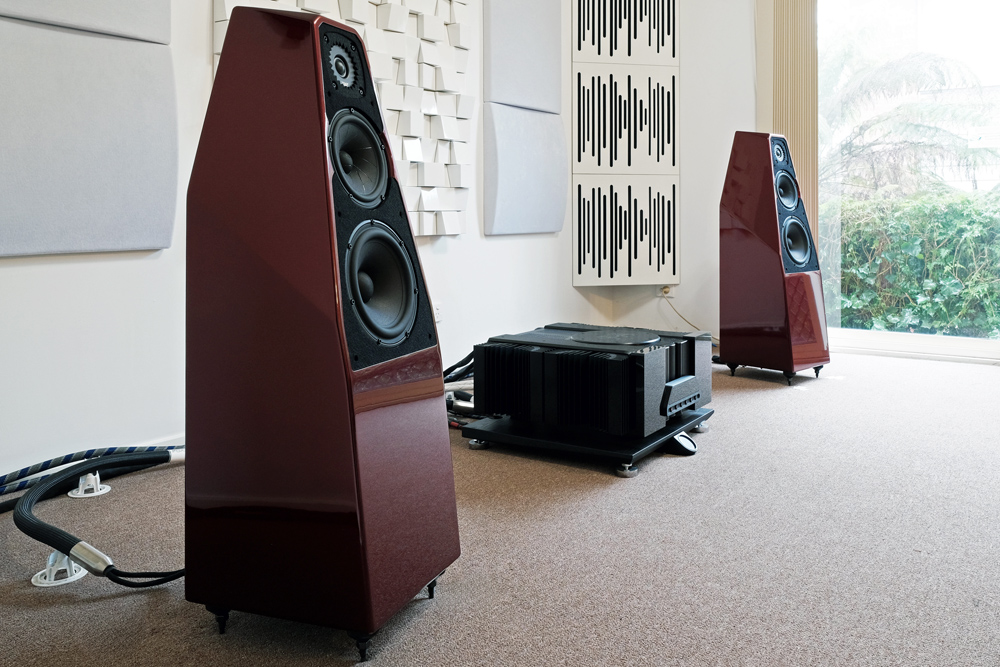
Lately, I’ve been thinking about how we may have reached a point in loudspeaker design where the immovable laws of physics are being… nudged. Possibly, ever so slightly stress-bent even. In my recent experience, the humble small floorstander has been amped-up, particularly in the areas of dynamics and low frequency extension. Modern design tools, computer simulation software, advanced measurement systems and refined testing techniques have enabled clever engineers to maximise every last drop of performance. These efforts are further bolstered by updated driver technologies, improved crossover components, and the implementation of advanced materials. The result is a new generation of relatively compact speakers capable of delivering extraordinary scale and authority. Have we entered a Golden Age of speaker design? The answer may well be in the affirmative. Wilson Audio’s newest creation, the Sabrina V, is a modestly-sized floorstander that sounds downright… BIG. Let’s take a closer look.
The Name of the Rose
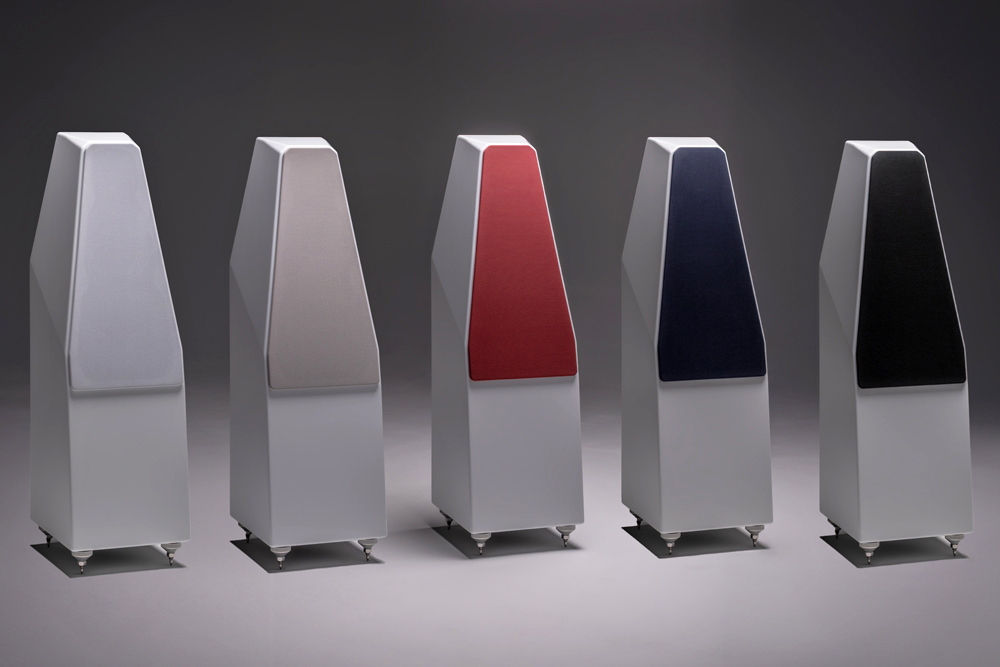
I should note from the get-go that I may well have, in my red-right-hand, one of the very first samples of Sabrina V dressed in a beautiful new finish. Wilson Audio has recently introduced a range of premium WilsonGloss finishes the company calls ‘Colours of the World’. My review sample is among the earliest out, finished in ‘Crowned Rose’. This striking tone blends high polish deep gloss with a saturated crimson generously flecked with metallic golden glitter. The Colours of the World palette also includes ‘True Gold’, ‘Island Breeze’, ‘Sagebrush’, ‘Ethereal White’, ‘Red Rock Sunset’, and ‘New Zealand Black Sand’. Each is a remarkable example of modern paint workmanship executed in one of the industry’s most exacting paint booth operations.
For a good representation of what these stunning finishes look like IRL, I’d highly recommend hitting up the Wilson Audio website’s Colours of the World page here. Your local Wilson Audio dealer will also have a complete WilsonGloss sample board.
While the expanded colour palette opens up a wide world of mix-n-match possibilities including metalwork finishes and grille colours, it’s the Sabrina V’s subtle design enhancements that tie it all together in a surprisingly coherent aesthetic. When I first saw the two Sabrinas side by side on static display at High End Munich 2025, they looked just about identical. Yet somehow V looked more elegant than X. It’s the cumulative effect of Sabrina V’s subtle styling refinements. That trimmed felt and tighter border around the midrange driver, the extended baffle length, the lower and sharper-angled chisel on the side panels, all deliver a more refined, less brutally chunky in-room presence. Yes, minor enhancements but holistically significant.
Beyond styling, Sabrina V ramps-up from its predecessor, the award winning Sabrina X (review here), with advancements across multiple key areas, lifting the entry point into Wilson Audio’s floorstanding speakers to a whole ‘nother level. This evolution revises driver technology and crossover topology while upgrading cabinet architecture and materials. Naturally, these engineering improvements add up to a speaker with even greater sonic performance potential (more on that later, of course).
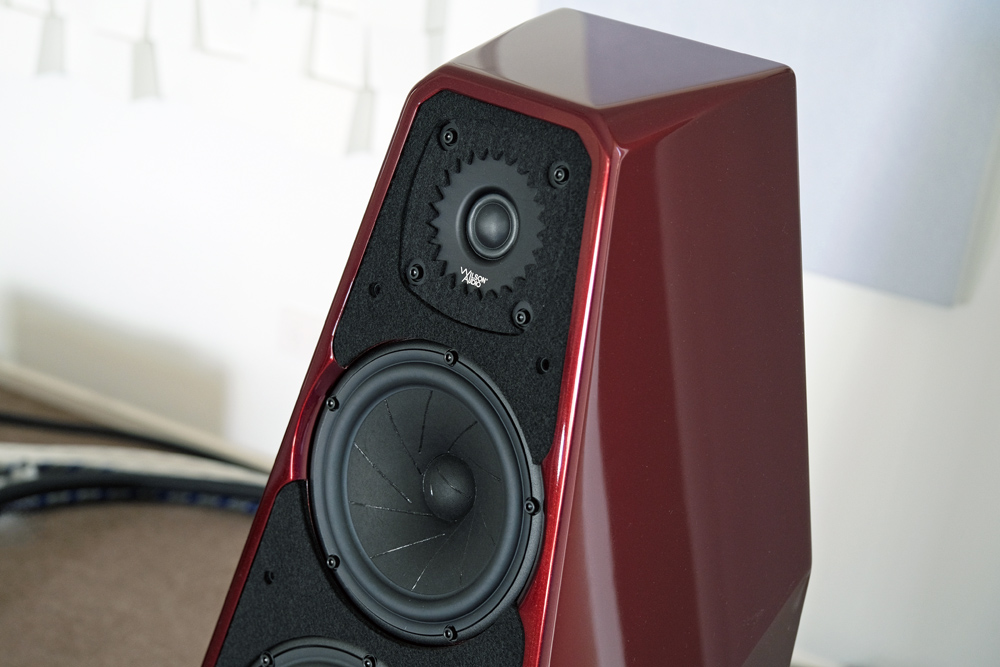
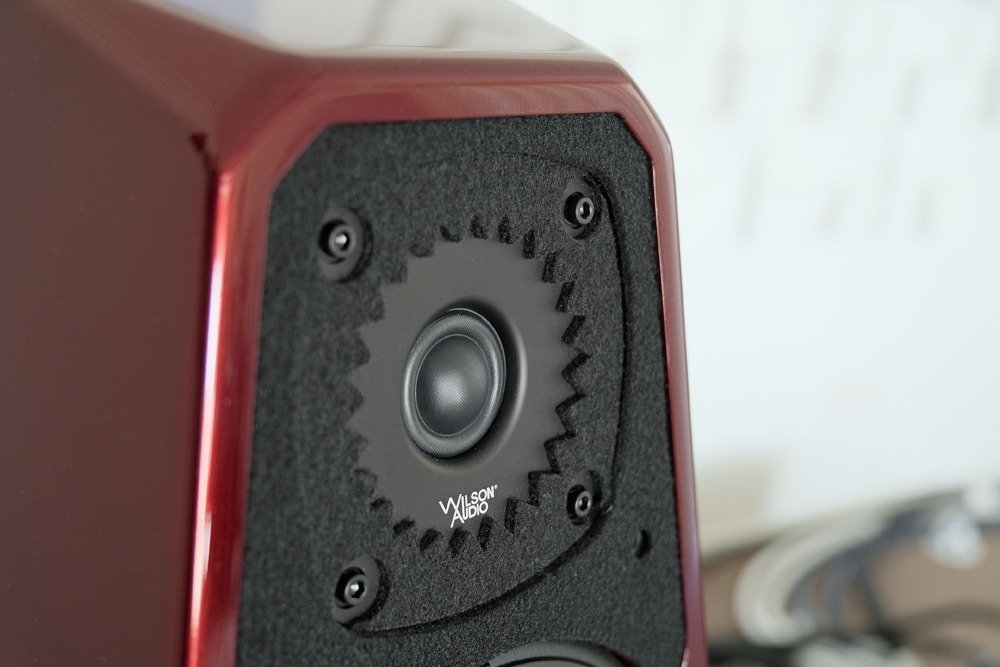
Sabrina V is a 3-way design, with its upper-most driver being Wilson Audio’s Convergent Synergy Carbon (CSC) 25mm (1 inch) lightly doped fabric dome tweeter. The CSC tweeter is housed within a dedicated sealed enclosure and is derived from the Alexx V, Wilson Audio’s large floorstander positioned one rung below the flagship Chronosonic XVX.
This trickle down approach is typical Wilson Audio. That means that top-shelf drivers employed in the company’s far more ambitious – and expensive – speakers cascade down to more accessible entry level models. This strategy brings Wilson Audio’s latest technologies in a way that preserves the current ‘house sound’ consistently across the entire model line-up, from the large highly sophisticated models down to this more accessible entry point. Having said that, at nearly AU$50K, Sabrina V sits at a price point on par with flagship, or near-flagship, offerings from many other manufacturers, while “more accessible” does not mean basic.
The CSC tweeter hands over to Wilson Audio’s bespoke QuadraMag driver, a 180 mm (7 inch) midrange driver with a paper pulp composite cone first developed for Wilson Audio’s flagship Chronosonic XVX. It’s also been employed, prior to its application in Sabrina V, in The WATT/Puppy, Sasha V, Alexia V (my reference speakers) and Alexx V up-tier models.
This midrange driver features a powerful AlNiCo (Aluminium, Nickel, and Cobalt) four magnet arrangement. Ergo QuadraMag. AlNiCo drivers were first developed in the 1930s and were adapted in loudspeaker driver design in the 1940s. In the main, they were used in woofers with great success by JBL, Altec/Lansing, Klipsch and Tannoy. Many of these manufacturers’ AlNiCo-based designs are considered vintage classics.
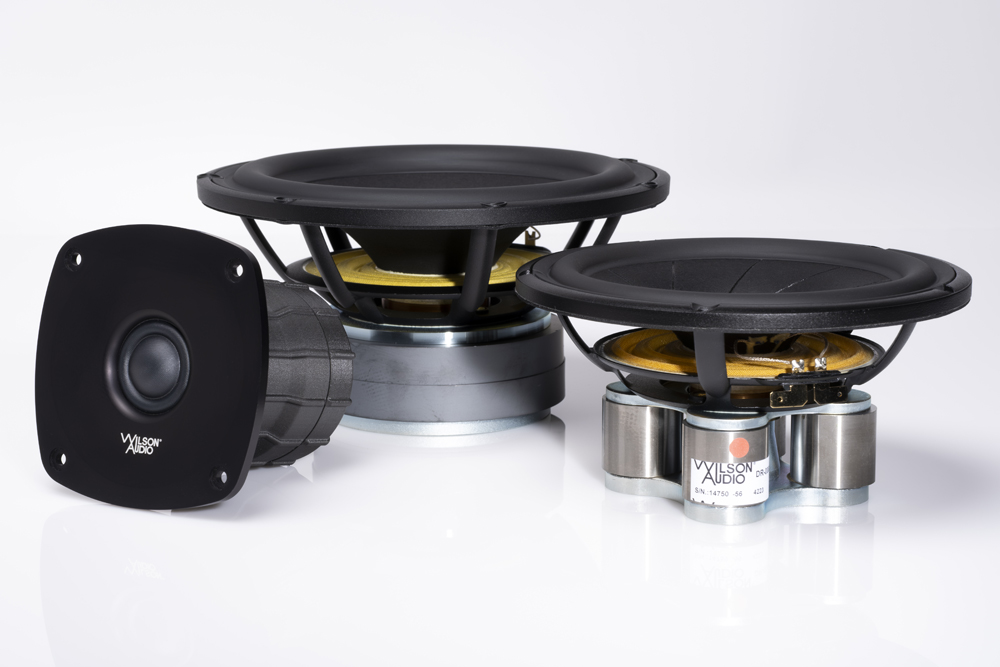
Now, 21st century materials and improved fabrication technologies have motivated a resurgence of these magnet motor systems prized for their warm, full-bodied, yet detailed sound. It’s worth noting too that, beyond what many believe is superior sound quality, AlNiCo magnet systems are more costly. The trade-off to added cost is higher magnetic strength, temperature stability, linear frequency response, high power/low distortion (makes them highly popular in high-end professional studio monitors), and more.
The QuadraMag driver is housed in a bespoke sub-enclosure which features a slot vent positioned up high on the cabinet’s rear panel. The vent is damped with an internal foam cover that aims to provide some airflow resistance and shifts the tuning frequency. In theory, this should yield a cleaner, clearer midrange response.
The low frequencies are handled by a 200 mm (8 inches) high power woofer also employed in Sasha V and The WATT/Puppy. It features a paper pulp cone and large ferrite/ceramic magnet system. The woofer is supported by a wide reflex port on the Sabrina V’s rear panel. This is not a plastic port, as commonly used by other makers, but is machined from metal, is neatly polished, and features a large diameter rounded air exit designed to prevent chuffing (air velocity/turbulence noise).
The new drivers and the revised cabinet architecture have led to a redesign of the crossover network. The handcrafted crossover features a point-to-point topology, a labour intensive approach that is regarded as being sonically superior to conventional circuit board layouts.
The network features a new copper version of Wilson Audio’s (ex-Reliable Caps) in-house produced AudioCapX-WA first introduced for Sasha V. The ultra-tight tolerance capacitors feature a copper “end-spray” that is said to refine the high frequencies. In Wilson Audio’s words, “… Rel-Caps deliver exceptional low-level resolution and tonal subtleties”. Also new is the incorporation of a new woofer capacitor said to improve the transition in the bandwidth between the mids and the low frequencies.
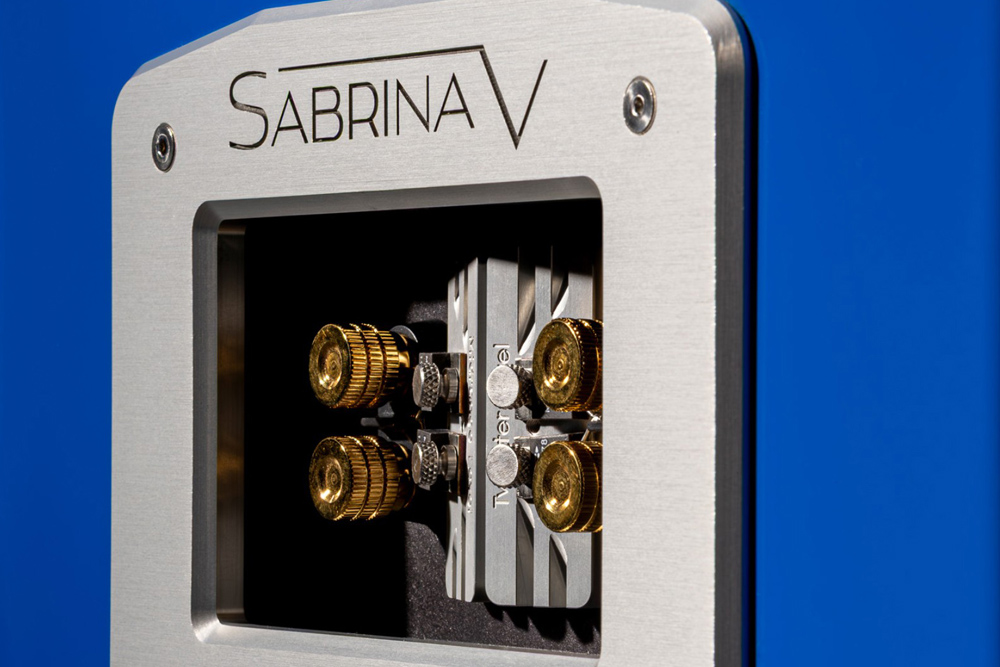
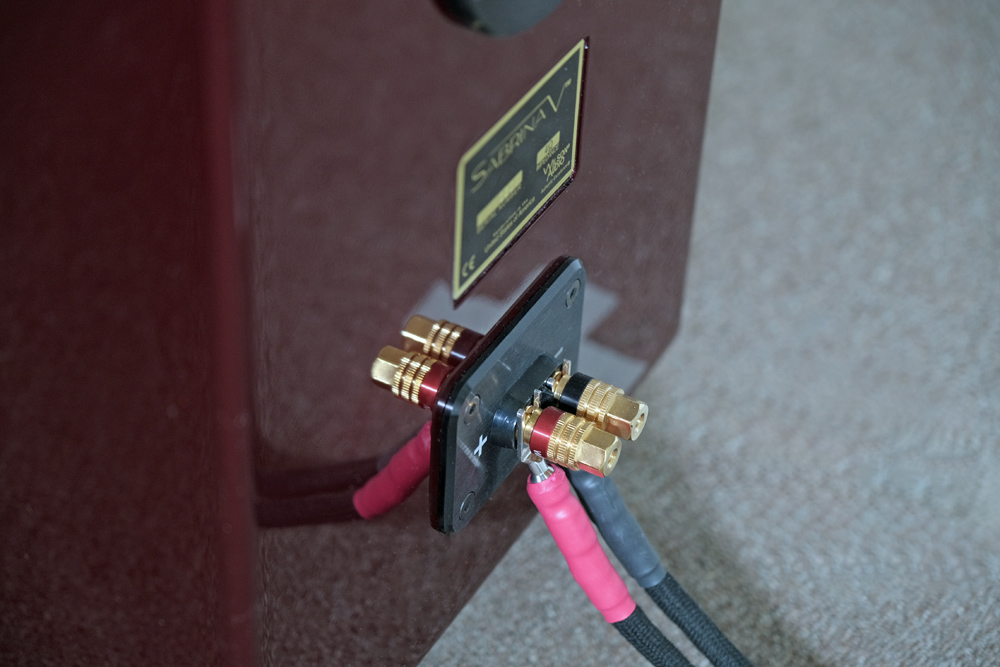
A new design touch now offers access to the network’s high quality Caddock resistors via a small, recessed panel on Sabrina V’s rear. The resistors are coupled to the tweeter and midrange drivers and, in the unlikely event that a resistor needs replacing, the process is now entirely user-friendly and tool and solder-free. It’s just a matter of manually disconnecting the resistor tails from the gold‑plated clamp-down binding posts (thumbscrews in Wilson Audio-speak) and reconnecting the new resistor to the network. The resistors can also be swapped out for alternative values (available from Wilson Audio), offering a degree of fine-tuning and sonic personalisation. The resistor panel features a machined aluminium frame adorned with the company logo. As per all the Sabrina V’s metalwork, it can be specified in either black or natural silver.
While drivers and crossovers obviously play an important part in any loudspeaker design, Wilson Audio also places significant emphasis and dedicates substantial R&D to the speakers’ cabinet design and architecture. Over the years, the company has developed a range of proprietary polymer composite materials, each formulated to enhance driver performance and to manipulate the cabinet’s acoustic and vibrational behaviour.
Sabrina V introduces the new H-Material compound, adopting it into the baffle construction. The new formulation is similar to X-Material, however, while being inflexible, H-Material is said to be slightly “softer” and more suitable to its task within the Sabrina V architecture. The make-up of H-Material features a high-density composite with “organic and phenolic properties”. Wilson Audio states the use of H-Material allows the QuadraMag driver to sound even more musical than the midrange implementation on Sabrina X.
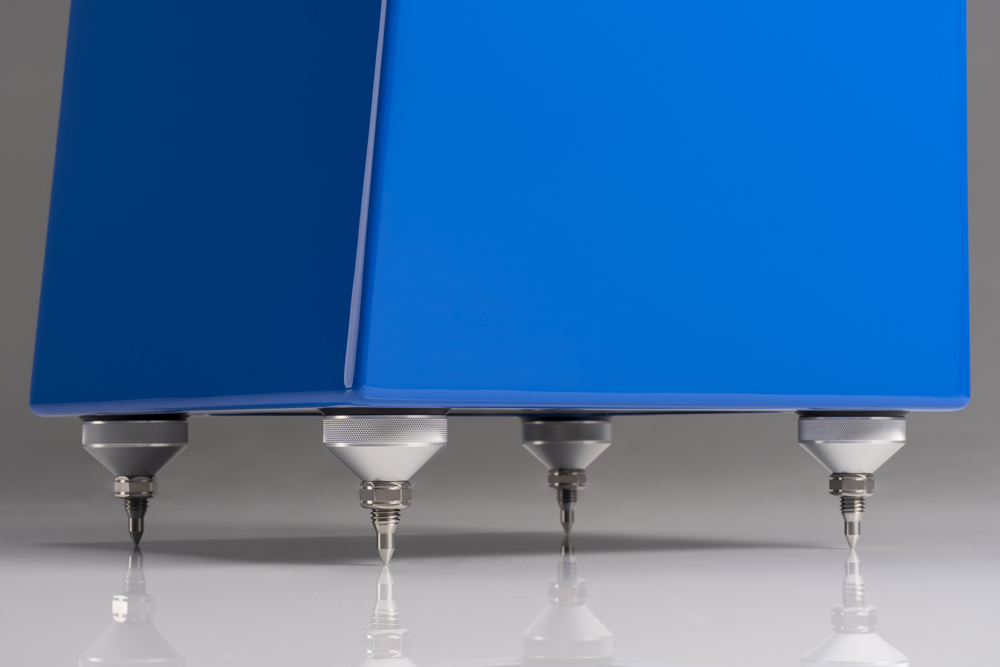
Also new on Sabrina V is the integration of V-Material within the speaker’s bottom panel, a strategy Wilson Audio calls V-MCD. Now, bottom panel inserts made from V-Material interface directly with the spike diode system. On Sasha V and models above, the supplied Wilson Audio Acoustic Diode spiking system actually integrates V-Material into the Acoustic Diode itself, rather than into the speaker’s bottom panel. Of course, should the speaker/room interface demand a more robust isolation strategy, the Wilson Audio Acoustic Diode system shares the same diameter and thread size, opening the opportunity for upgrading.
Wilson Audio specifies the Sabrina V’s frequency response to run from 27 Hz to 24 kHz at +/- 3 dB Room Average Response (RAR) while the system sensitivity and nominal impedance are given at 87 dB at 1 watt/1 m/1 kHz and 4 ohms (2.23 ohms at 121 Hz) respectively. Minimum amplifier power is suggested at 50 watts.
Are We Music?
I love this quote from Albert Einstein: “We are slowed down sound and light waves, a walking bundle of frequencies tuned into the music of the cosmos, we are souls dressed up in sacred biochemical garments, and our bodies are the instruments through which our souls play the music.” Man, if only, in all my reviews, I could consistently express my emotions to his level of fluidity and poetic beauty. Yeah, I’m no Einstein.
There’s a slight over-emphasis in the overall low frequency spectrum, making Sabrina V sound like an overachiever in that area. Shut your eyes and you’ll be convinced you’re listening to a larger speaker… WATT/Puppy perhaps? Yet no, it’s the bigger bro’s little sister proclaiming “Hey, dude! Don’t be painting me with no broad brush!”.
Yet, while that may sound like I’m alluding to some form of unbalanced bottom heavy presentation, let me tell you it’s not. It’s just that Sabrina V expertly treads the fine line between being extra in the bass and blending it, quite seamlessly I might add, to the very present, live-sounding and all-crucial midrange. In fact, comparing Sabrina V with my Alexia V, I’d say the former has a slightly more forward midrange presentation.
Take the choral and organ cover of Bob Dylan’s “Make You Feel My Love” from organist Anna Lapwood’s Firedove album, a live production recorded in the Nidaros Cathedral, Norway. Here, the enormous in-room presence of the Chapel Choir of Pembroke College, Cambridge flawlessly merges with the cathedral’s near-10,000 pipes Steinmeyer organ as it progressively swells in intensity towards the track’s powerful conclusion. Each choral section is clearly discernible against, or should I say, in unison with, the organ’s rising tide. Ooh yeah, Sabrina V plumbs the depths with no issue whatsoever.
Mei Semones’ delicate vocals on “Donguri” from her Animaru album is an exercise in how to render beautiful female vocals. Sabrina V tackles both Simones’ gentle guitar strands and equally delicate vocals while the bass solo plays with texture, tight attack and, simultaneously, rounded fullness. The QuadraMag driver’s fullness and its small sprinkle of warmth provide a natural ‘real life’ quality without impinging on exceptional micro-grain detail retrieval.
Sabrina V can scale, big time, with immense soundstage dimensionality while sharply retaining image specificity, if your room allows it. On oud virtuoso Joseph Tawadros’ Live at the Sydney Opera House, an ABC production on the ABC Classic label marrying Middle Eastern and European classical music, the Concert Hall’s ambience and its spatial magnitude are exceptionally well represented, offering an aural vision with a striking facsimile of the venue’s acoustics (this recording was produced prior to the new acoustic design by Germany’s Müller – BBM Building Solutions in 2022). Prior to its renovation, the Concert Hall had distinctly live acoustic signature, which is clearly captured by the ABC engineers and is then carried through to that magic marvel-chain of electronics and transducers into your listening space. The Concert Hall’s magnitude (I’ve been there countless times…) is convincingly rendered into the illusion, that mirage which tricks the ear/brain into almost believing you’re at the great hall itself (and yes, that almost term is so subjective). Tawadros is placed forward and to conductor Benjamin Northey’s left, with the Sydney Symphony Orchestra fanning out on a massively wide, high, and deep soundstage.
There’s no denying the excellence of the CSC tweeter. On Lucrecia Dalt’s “Bochinche” from the ¡Ay! album, the bells at the end of the track sounded pure, metallic, and adorned with a stunning sense of harmonics and natural decay. Not a trace of artifice, just purity, effortless extension and arresting realism.
I was super impressed with how precisely Sabrina V untangled the complexities of busy multi-instrument tracks like “A Little Rice and Beans” from the Wooten, Chambers, Franceschini album Tryptnotyx. With the kick drum, bass and saxophone all playing in unison, each was a defined ripple within the musical stream. The drum solo around the track’s three-quarter mark slams hard and Sabrina V responds with impressive authority, detail, and transient control. The interplay between snare, tom and kick drums is dramatically powerful. I’m talking about a dynamic expression akin to relatively large floorstanders.
Do you value tonal density, a textural richness that shifts seamlessly between light and dark, and an accuracy that faithfully captures the spectrum of vocal and instrumental signatures? Yeah, Sabrina V will deliver those attributes with a veracity that highlights the capabilities of the QuadraMag and CSC tweeter combo. The timbral subtleties between the acoustic guitar, Ehru, percussion and the male vocal on “Ama Jara (Desert Version)” on Duplessy & The Violins of the World’s album The Road With You was not just precisely rendered but also exposed every subtle nuance in the devastatingly beautiful composition. Across various tracks on the album, the string instruments are joined by the Morin Khuur and Sarangi where their inherent qualities are equally reproduced with stunning precision.
Conclusion
With each generation, Wilson Audio consistently embellishes its latest loudspeaker creations with carefully down-filtered technologies derived from its flagship models. Many of those technologies have been applied to Sabrina V, but the newest speaker also introduces H-Material, a structural ingredient that adds engineering refinement. Plus, the optional Colours of the World sprinkles an appetising spice to the overall recipe.
The Sabrina V may indeed be a small-to-mid-sized floorstander yet, in typical Wilson Audio fashion, the new loudspeaker absolutely captivates with an illusion that tricks the mind, delights the heart, and feeds the soul. In my room, it uncannily approached The WATT/Puppy performance envelope… not quite there but, yes, Sabrina V possesses a thorough complement of abilities.
Yeah, in answer to the question posed in the intro, I think indeed, we’re in a Golden Age. Be prepared, I tell ya: the Sabrina V will disrupt your preconceptions of what a speaker of this physical stature can deliver in terms of scale, dynamics and low frequency reach. Add to that Sabrina V’s outstanding performance across the bandwidth and you have, spiked firmly to your room’s floor, a beautiful overachiever.
… Edgar Kramer
This email address is being protected from spambots. You need JavaScript enabled to view it.
Associated Equipment
- Speakers — Wilson Audio Alexia V, Axis Loudspeakers VoiceBox S (nearfield monitor), Vermouth Audio Little Luccas Mk.II Limited Edition, Atacama stands
- Amplifier — Gryphon Audio Antileon EVO
- Preamplifier — Supratek Cortese, Totaldac d1-triunity (periodically, direct to amplifier)
- Sources — Digital: 432 EVO Aeon Mk.3 Reference Music Server/Roon Core, Yamaha CD-S2100 transport, Totaldac d1-triunity DAC. Analogue: Transrotor Crescendo with Konstant Studio controller, Reed 1X Tonearm with upgraded internal wiring, Shelter Harmony cartridge, The Funk Firm Houdini cartridge decoupler, Supratek Cortese & REDGUM Audio RGPH2 phono stages
- Processor — DEQX PreMate (part of arsenal/casual use)
- Cables — VYDA Laboratories Orion Silver Reference HFC IC and speaker cables, Cerious Technologies Lumniscate loom, PSC Audio custom design XLR, Vermouth Audio Reference loom, Tubulus Concentus USB
- Audio Rack — SGR Audio Statement MODEL V, Aspire Audio Belgravia amplifier platform (customised for Gryphon Audio Antileon EVO), Stereotech Aluminar Dark 3-tier rack
- Acoustic Treatment — Vicoustic Multifuser Wood, Wavewood Ultra, Cinema Round Premium and Super Bass Extreme
- Miscellaneous — Silent Angel Bonn N8 Pro network switch, GigaWatt PF-1 EVO power strip, Les Davis Audio Viscoelastic CLD discs, Voodoo Cable Iso-Pods, Bocchino Audio Mecado, Secret Chord Analogue Record Restore, plus miscellaneous accessories
Wilson Audio Sabrina V Loudspeakers
Price: AU$49,995
Australian Warranty: Five Years
Australian Dealers:
NSW – Audio Connection, VIC – Sound Gallery, Tivoli Hi-Fi, QLD – Trimira Audio, ACT – Miranda Hi-Fi, WA – Frank Prowse Hi-Fi, (NZ – Paul Money Hi-Fi)
Australian Distributor: Advance Audio Australia
+61 2 9561 0799
www.advanceaudio.com.au
Wilson Audio Specialties
2233 Mountain Vista Lane
Provo, Utah 84606
United States of America
1 801 377-2233
www.wilsonaudio.com