




There’s a sizable cohort in the audio enthusiast pool that holds the classic 2-way standmount close to its heart. Granted, there’s a type of magic to a well-sorted 2-way. The narrow baffle, the inherently stiff enclosure, the simplicity of a crossover network charged to managing just two drivers. Yes, there’s a sonic purity and spatial grandeur that is, understandably, beguiling. But what if that same spell could also be cast by a floorstander? One that shares the compact footprint of a 2-way, replacing the speaker stand with added cabinet volume to extend bandwidth. One capable of delivering near full-range performance through a simple, elegant, and less commonly adopted 2.5-way architecture. Tempting, right, you standmount lovers, you? Enter the astonishingly adept Achema, handcrafted in Italy and the first release in a new line from Albedo Audio. Let’s take a closer look.
Frequency Transmission
To the questions above? Hell, yeah! How could anyone deny the appeal of a 2.5-way speaker that mimics the performance virtues so desired by 2-way standmount aficionados yet delivers them in a broader package. Yes, such a speaker would retain the coveted coherence and imaging precision while adding the missing octaves and a larger sense of scale that comes closer to an authentic musical experience. That’s indeed the story told by the Achema speakers which add spice to the mix by further extending its low frequency capabilities via its transmission line design.
I was curious as to what the word Achema actually meant. I thought it might be of Italian or Latin origin, yet I couldn’t find evidence of that online. Search results actually revealed its African origins. One meaning is “Everyone is related one way or another” (yes, music can be an adhesive that does tie us all together), while yet another African description is “Overpowering” (the Albedo speaker certainly conjures power beyond its size). A Turkish meaning states “Opening”, which I’d confirm as an invitation to truly engage with music. Achema is all of those things and more.
I’ll start by describing the container in which Achema made its journey to SoundStage! Australia. Arriving on a pallet, each Achema baby is nursed in a well-foamed cradle within a heavy duty cardboard box. However, this is a container with a difference. Each box is held together with cloth straps that, once unclipped (strong metal clips), basically allows the box to be dismantled around the speaker. The heavy-duty spikes are pre-installed, so no need for lifting and balancing the speaker while installing the spikes. Once upright, just simply pivot-walk Achema to the preliminary room position. Done in five minutes. Simple, excellent packaging.
Albedo Audio is partial to the superlative Accuton drivers from Thiel & Partner, as also applied to the company’s Agadia and Acclara upscale models which have inspired Achema. I’m told the drivers are modified to Albedo Audio’s specifications.
Achema incorporates a 25 mm Accuton ceramic dome tweeter featuring ‘CELL’ technology and a vented voice coil. The large coil is powered by an FEA-optimised underhung magnet motor. The design eschews cooling ferrofluid. It’s a high power, low distortion driver with a well-damped dome featuring a soft fabric surround.
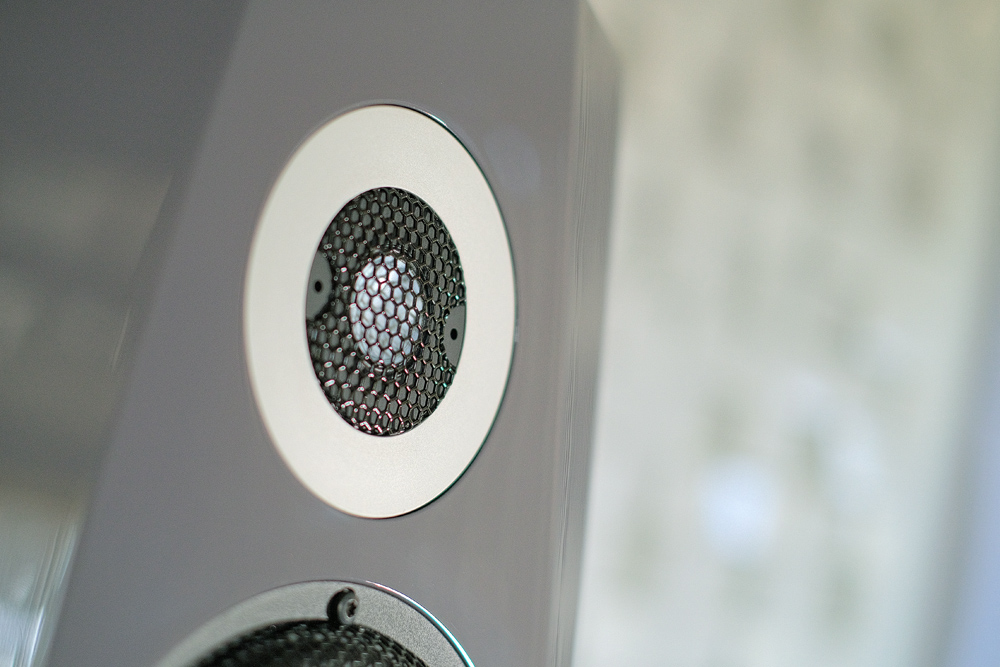
Below the tweeter is an Accuton CELL 158 mm long excursion ceramic mid-woofer which handles an extended bandwidth from 2.6 kHz in the midrange down to the upper low frequencies as far as 300 Hz, as is the norm for a 2.5-way design. That driver features a 38 mm titanium vented voice coil former and a powerful underhung magnet system.
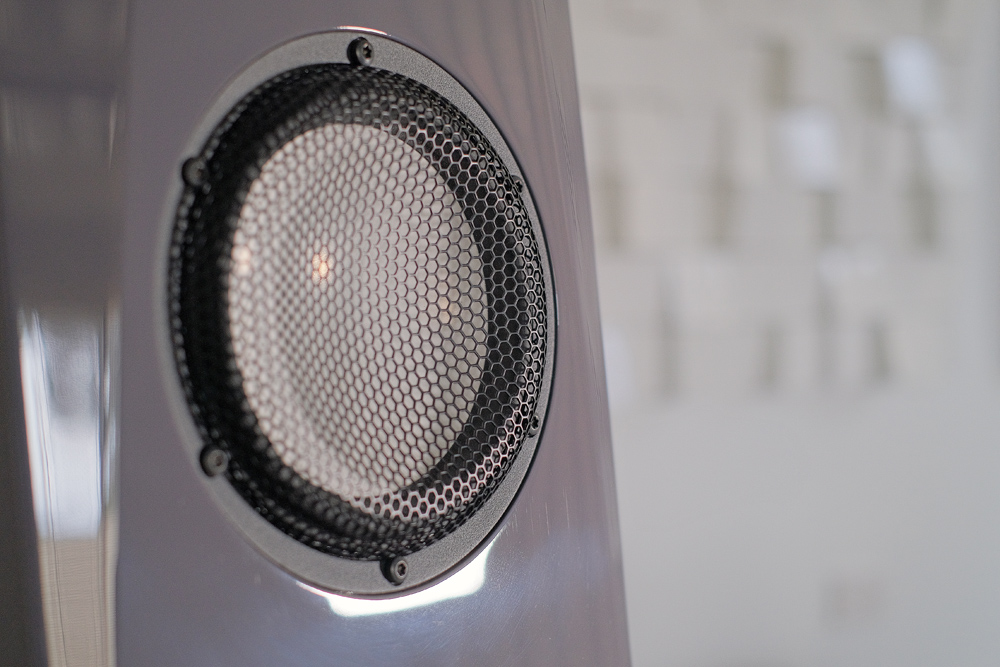
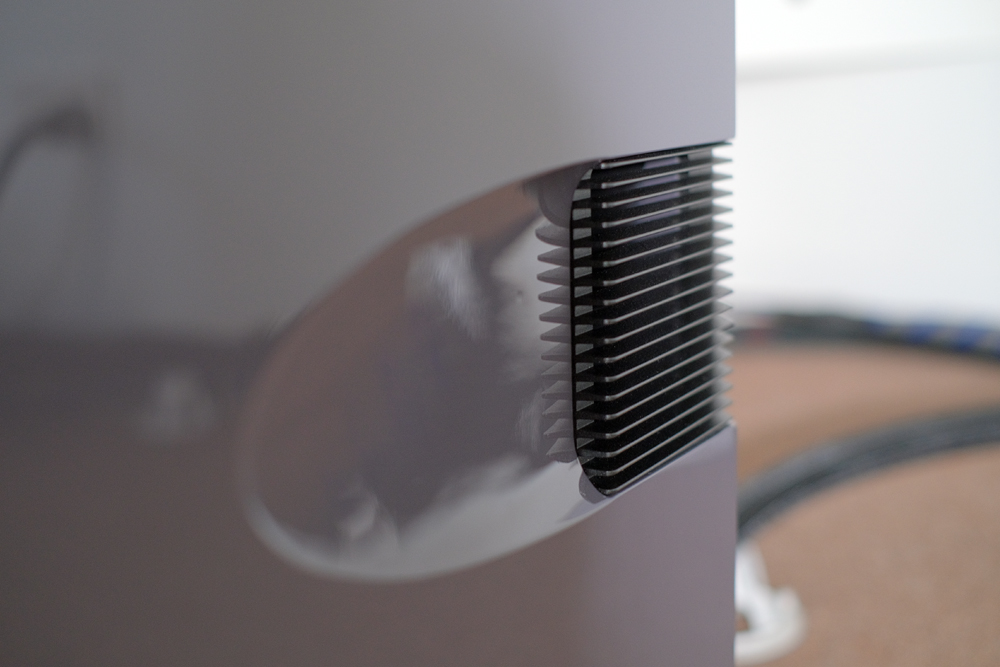
While almost identical visually, the third Accuton ceramic driver is a 173 mm driver also sporting a 38 mm titanium vented voice coil. The driver handles the low frequencies from 300 Hz to 44 Hz. However, now it gets a little different. The bass driver is supported by a ‘Helmholine System’, which is Albedo-speak for a carefully designed transmission line that directs the woofer’s rear wave through a series of damped, variable-sized channels, or paths, before exiting the enclosure via relatively small vents, one each on the speaker’s side panels.
In Achema, the transmission line (TL) incorporates custom-designed Helmholtz resonators that tailor the TL’s sonic performance. It’s not a trivial approach in terms of its execution, but when well-engineered, with precisely calculated dimensions, a transmission line strategy can result in deeper low frequency extension and a fuller, more open sound presentation. The bass performance I experienced through the auditioning stages would belie the 44 Hz specification (no parameters given), with my subjective impressions affirming a powerful and far deeper output.
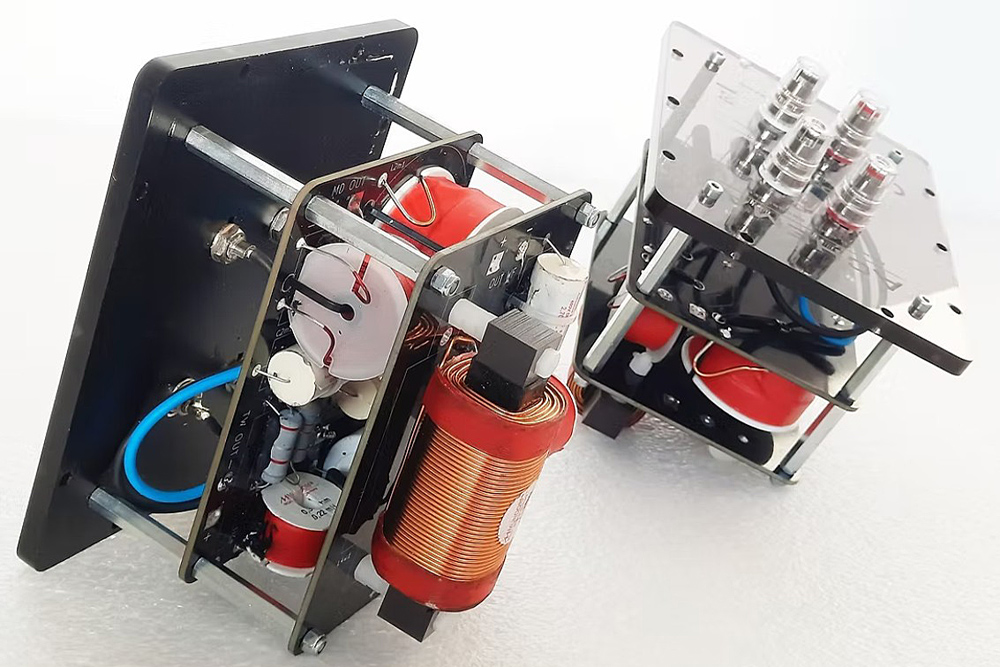
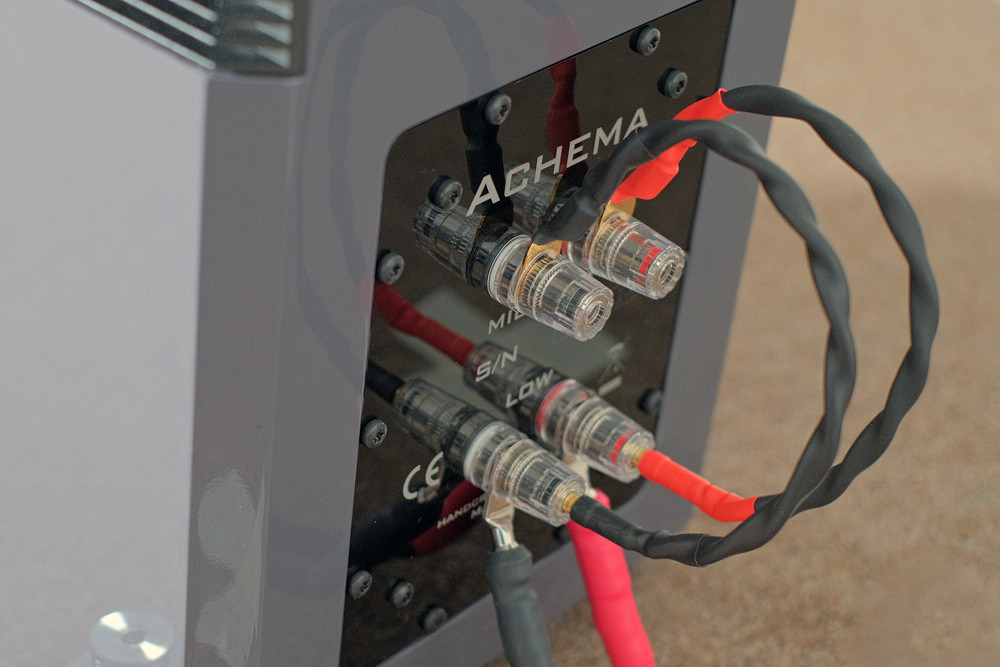
Achema’s 2.5-way configuration is derived from a handmade crossover network employing a mix of 1st- and 2nd-order filters said to feature high quality components from Germany’s Mundorf. Albedo Audio engineers have aimed at achieving a “Geometrically optimized driver alignment, ensuring correct acoustic centre positioning.” Presumably, this is attained by a combination of crossover topology and Achema’s angled/slanted baffle design that aligns the driver acoustic centres. The crossover is designed for phase linearity, “minimizing temporal mismatches between transducers”. In order to minimise vibrational distortions, the network is isolated within its own compartment. Short signal paths are maintained via the copper tracks which have been configured to reduce potential magnetic field interactions. Cabling between crossover and drivers is from Van den Hul. Bi-wiring is available, with Albedo Audio providing short, high quality cable jumpers for single- wire installations.
As I mentioned above, Achema’s frequency response specifications do not reflect its output, however, Albedo Audio provides an FR spanning from 44 Hz to 22 kHz (no parameters provided), while the impedance is given as an unusually high 11 ohms, and an average sensitivity of 85dB (2.83V/1 metre). The impedance specification points to a speaker with low current demands, therefore suitable for both solid state and valve-based amplification of medium-to-high power, given the 85dB sensitivity.
The new cabinet design is beautifully styled and immaculately finished, with the review pair provided in a lacquered lavender-ish/lilac-ish paint finish the company calls ‘Grey Pastel’. The cabinet is solidly built, with panels up to 30 mm thick on “critical points”. In addition to the slanted front baffle, the top panel is also angled backwards, the result being that there are no parallel sides to the cabinet. This is a good thing; it avoids internal standing waves. The front baffle is sculpted (with softened edges), narrowing on either side of the tweeter and midrange driver, providing reduced diffraction effects. The transmission line vents from the cabinet’s side panels via a grilled exit port. Albedo Audio has designed the vents to minimise airflow “turbulence” via the outlets.
I contacted Albedo Audio’s co-founder and CEO Cristiano Bastianelli to get some personal insights on Achema’s design priorities:
The Achema loudspeaker was born from an ambitious goal: to create a speaker that, thanks to its intrinsic qualities, could perform optimally and express its full potential.
To achieve this, we developed custom drivers featuring a high-impedance voice coil, whose electromagnetic characteristics are perfectly matched to our new crossover filter architecture. Naturally, to ensure greater dynamics and power handling, we chose a 38 mm vented voice coil for both transducers. Its superior heat-dissipation capabilities allow distortion levels to remain even lower.
With the same objective in mind, we adopted a different kind of 2.5-way configuration—our own technique. By employing a larger midrange driver, we increased air damping; and thanks to its greater cone area and mass, we were able to take advantage of its natural attenuation properties to create a far more transparent low-pass filter, free from the typical losses and signal distortions found in conventional designs.
I prompted Bastianelli to provide a little more detail on Achema’s transmission line bass strategy, which is also employed across Albedo Audio’s entire stereo speaker range (a reflex system is used on the Alma centre channel).
To fully exploit the potential of transmission line architecture, an innovative, highly optimized TL system has been developed. This approach represents a substantial advancement in modern transmission line engineering, improving both the quality and consistency of bass performance. The Helmholine System represents one of the most distinctive innovations within the Albedo design platform. It operates by selectively attenuating unwanted frequencies through a network of precisely tuned Helmholtz resonators, functioning as an acoustic filter embedded within the enclosure architecture. Beyond frequency filtering, the Helmholine System provides a more uniform acoustic load on the driver across its operational bandwidth, improving linearity and overall control of cone motion.
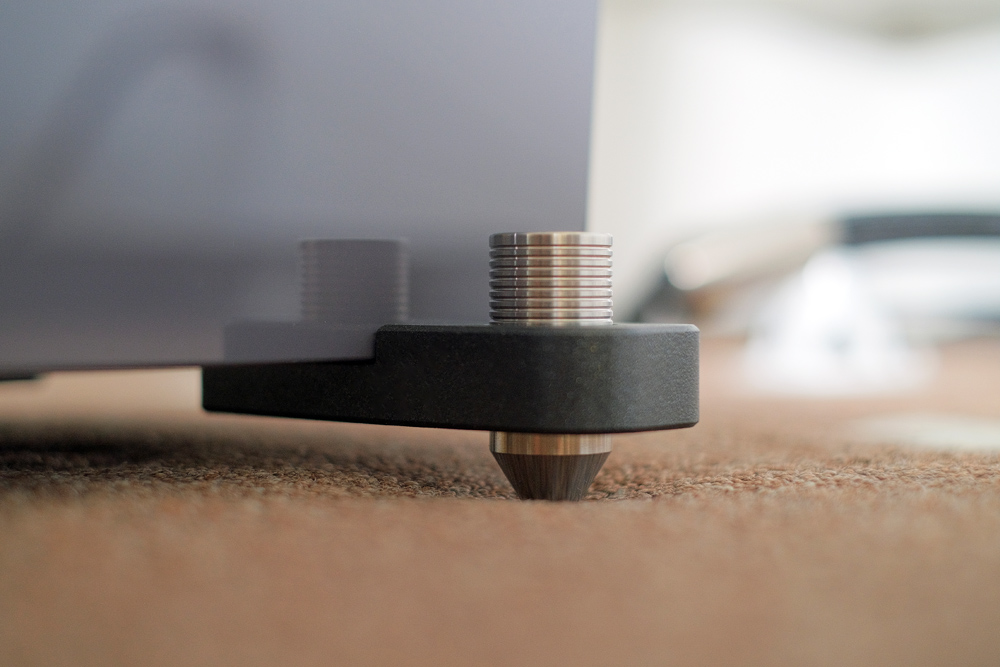
Achema sits on a pre-installed thick metal outrigger and is factory-fitted with heavy-duty spikes which can be adjusted from above. Metal disc floor protectors are also provided, as are an Allen key spike adjustor, a special cleaning liquid, and microfibre cloth for cabinet care. A signed and wax-stamped ‘Certificate of Authenticity’ sheet is also an item found in the accessories kit box.
In my humble opinion, beyond the solid engineering applied to the Achema design, when seen ‘in the flesh’, the Achema loudspeakers are well-stylish. It’s a flawlessly finished, elegant design that balances its overall proportion with a subtly sculpted form that gracefully signals ‘la moda Italiana’.
Resonating Truth
Achema is not an overly demanding design in terms of in-room placement. I started off where most speakers tend to work in my studio, which is approximately 1.5 m from the front wall, about 0.8 m from side walls, and just over 2.4 m apart. Making minor adjustments of a couple of inches, or so, balanced and tightened the low frequencies to my satisfaction. Further tweaking had me adjusting the speakers’ toe-in, the outcome being enhanced imaging and a more spacious soundstage.
When talking about a set of speakers’ soundstaging and imaging capabilities, there’s an archetypal inter-relationship automatically correlated to big designs and their inherent spatial grandeur. That’s usually a precise assumption, purely based on the cabinet size and number of drivers such designs are equipped with. However, I’ve experienced several extremely competent smaller speakers, both large standmounts and small floorstanders, that are very satisfying in terms of big presentations and surprising when it comes to belying their size. Achema is among the top echelon there.
Once the speakers were locked in place, I was struck by the sheer scale of spatial information Achema revealed. On Ryan Adams’ “Gimme Something Good” from the live album Ten Songs From Love at Carnegie Hall, Achema delivered a panoramic soundstage that reflected the grandeur of the iconic venue. There was a real sense of Carnegie Hall’s acoustic signature, and within that vast soundfield, Adams emerged as an authentically proportioned image. Adams modulates, or accentuates, his vocals in sections of each verse and chorus, and Achema tracked these very dynamic portions with ease and without straying into brightness.
The second aspect of Achema’s sonic merits that hit home straight away was the sheer low frequency strength. Yeah, Albedo Audio engineers, agreed… there’s something about this Helmholine thingamajig. Considering the cabinet’s dimensions and the relatively small-ish woofers onboard, the bass offered is impressive and in line with a larger box and bigger drivers. There’s no defying the laws of physics here, it’s just the TL doing its thing… but very well.
To illustrate this forcefully, literally, I streamed “Suck My Bass” from Bass Mekanik’s King of Bass album, a non-sensical exercise in low frequency excess that only warrants short listening spells (your gut will thank you). However, it did clearly demonstrate how much of that bass excess a speaker can comfortably reproduce. I was surprised and amazed by Achema’s handling of this outrageous recording, where the depth, control, and distortion-free power were outstanding (both the Supratek preamplifier and Gryphon Audio Antileon EVO amplifier play their part here). In fact, upon hearing the Achema’s bass, any visitor would be almost certainly asking the clichéd question “where’s the subwoofer?”.
As I’d expect from Accuton ceramic-based drivers, the Achema implementation also provided excellent levels of detail, especially from the upper midrange through to the highest frequencies. That equated to a pleasingly realistic female vocal immediacy. The semi-soft whisperings of Lucrecia Dalt on “El Galatzó” from her album ¡Ay! almost felt like a caress, such was the conveyed intimacy. The accompanying percussion instruments sounded exceptionally well separated, both from each other and Dalt’s voice, while the bells’ metallic timbre rang (pun intended) superbly true.
The Achema speakers don’t have a romantic, soft sounding signature. There’s no uncalled for warmth unless present in the recording. In other words, Achema is not coloured… it’s just faithful to the signal it’s being fed. Take the piano and acoustic guitar. These instruments were rendered with true tonal textures, left to right on the keyboard and up and down the strings. I’ve heard a deeper sense of ‘body’ from soft dome and paper/pulp-based drivers but perhaps those are somewhat less… precise (in most cases but not all).
“The Soul” from David Helbock Trio’s Into The Mystic album revealed profound levels of information, with the piano bass notes intro playing with a great sense of weight and authority. Then when Helbock glides across to the higher keys, the speed, attack and timbral character of the instrument were nothing if not truly satisfying. There were both gravitas and delicate subtlety on “Exodus to Star Wars 1”, a short track that fuses the very disparate themes from the classic movies’ soundtracks.
Brother and sister team Rodrigo and Gabriela burst onto the music scene from humble beginnings in the very early 2000s. The duo’s dexterity and control of the acoustic guitar, plus their creative reinventions of well-known tunes led to global success and a number of very popular album releases. One of the picks is the 2006 album Rodrigo y Gabriela on which the siblings smash out a stunning interpretation of Led Zeppelin’s “Stairway to Heaven”. Via the Achema, the clarity, transient attack and superb verisimilitude of the individual guitar sounds were immaculately reproduced.
On the intro to “Satori”, from the same album, the heavy strumming was dynamic and expertly separated, each strike’s initial impact clearly distinguished from the subsequent sum of the chord’s notes across the strings. Then as the individual notes come in, each pick and strike was cleanly articulated with excellent inner detail and rapid attack. When the instrumentalists drive-on for a fuller sound, Achema responded with a rounder, more complete presentation with satisfying musical weight.
I played a number of symphonies ranging from Beethoven through to Dvořák and, across a wide spectrum, to Tchaikovsky. The Achema speakers shone on this challenging material, projecting a sonic image on a grand scale. Panoramic vistas were opened into expansive venues, with large orchestras rendered in a manner in line with bigger speakers. Plus, the separation between winds, strings, percussion, and brass was vivid, allowing each section to fully and dramatically express within the expansive soundfield.
Man, kick drum in good rock recordings was solid. On Tool’s exceptional album Ænima, the track “Eulogy” features subtle percussive sounds (superbly done by Achema) which are then augmented by powerful and tight kick drum accents. Yeah, Achema punched above its weight, as they say. When it all explodes into the full-blown song, it was all gouging guitars, bobbing bass, and snapping snare, with Maynard James Keenan’s vocals “Don’t you step out of line, don’t you fucking lie!” cutting through the mix like a turbo-charged chainsaw. A rock lover’s delight.
Conclusion
Can a small floorstander truly excel across a wide bandwidth? Can a design endowed with two woofers under 180 mm deliver a presentation that is powerful, dynamic and rich in the low-frequencies while looking gorgeous and occupying minimal real estate? Albedo Audio’s stunning little Italian battler responds with a resounding “Yes, it can!”.
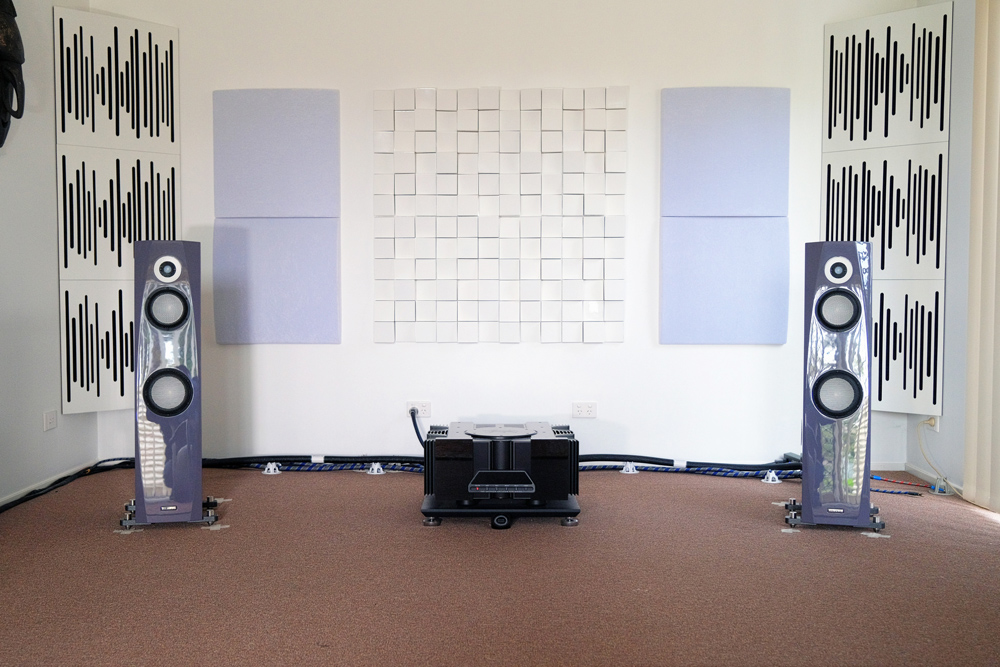
The Achema narrative is one of delivering performance that far exceeds expectations for a speaker of its size, even if its 2.5-way topology is, alas, seldom explored. Albedo Audio’s Achema is complete… and utterly compelling, proving that intelligent design embodied in a compact form can confidently inhabit the high-end space.
Unequivocally and enthusiastically recommended.
… Edgar Kramer
This email address is being protected from spambots. You need JavaScript enabled to view it.
Associated Equipment
- Speakers — Wilson Audio Alexia V, Axis Loudspeakers VoiceBox S (nearfield monitor), Vermouth Audio Little Luccas Mk.II Limited Edition, Atacama stands
- Amplifier — Gryphon Audio Antileon EVO
- Preamplifier — Supratek Cortese, Totaldac d1-triunity (periodically, direct to amplifier)
- Sources — Digital: 432 EVO Aeon Mk.3 Reference Music Server/Roon Core, Yamaha CD-S2100 transport, Totaldac d1-triunity DAC. Analogue: Transrotor Crescendo with Konstant Studio controller, Reed 1X Tonearm with upgraded internal wiring, Shelter Harmony cartridge, The Funk Firm Houdini cartridge decoupler, Supratek Cortese & REDGUM Audio RGPH2 phono stages
- Processor — DEQX PreMate (part of arsenal/casual use)
- Cables — VYDA Laboratories Orion Silver Reference HFC IC and speaker cables, Cerious Technologies Lumniscate loom, PSC Audio custom design XLR, Vermouth Audio Reference loom, Tubulus Concentus USB
- Audio Rack — SGR Audio Statement MODEL V, Aspire Audio Belgravia amplifier platform (customised for Gryphon Audio Antileon EVO), Stereotech Aluminar Dark 3-tier rack
- Acoustic Treatment — Vicoustic Multifuser Wood, Wavewood Ultra, Cinema Round Premium and Super Bass Extreme
- Miscellaneous — Silent Angel Bonn N8 Pro network switch, GigaWatt PF-1 EVO power strip, Les Davis Audio Viscoelastic CLD discs, Voodoo Cable Iso-Pods, Bocchino Audio Mecado, Secret Chord Analogue Record Restore, plus miscellaneous accessories
Albedo Audio Achema Loudspeakers
Price: AU$29,000
Australian Warranty: Five Years
Australian Distributor: Absolute Hi End
+61 488 777 999
www.absolutehiend.com
Music Tools & More srl
Via Pantanelli, 119/121
61025 Montelabbate (PU)
Italy
+39 0721 472 899
www.albedoaudio.com/