


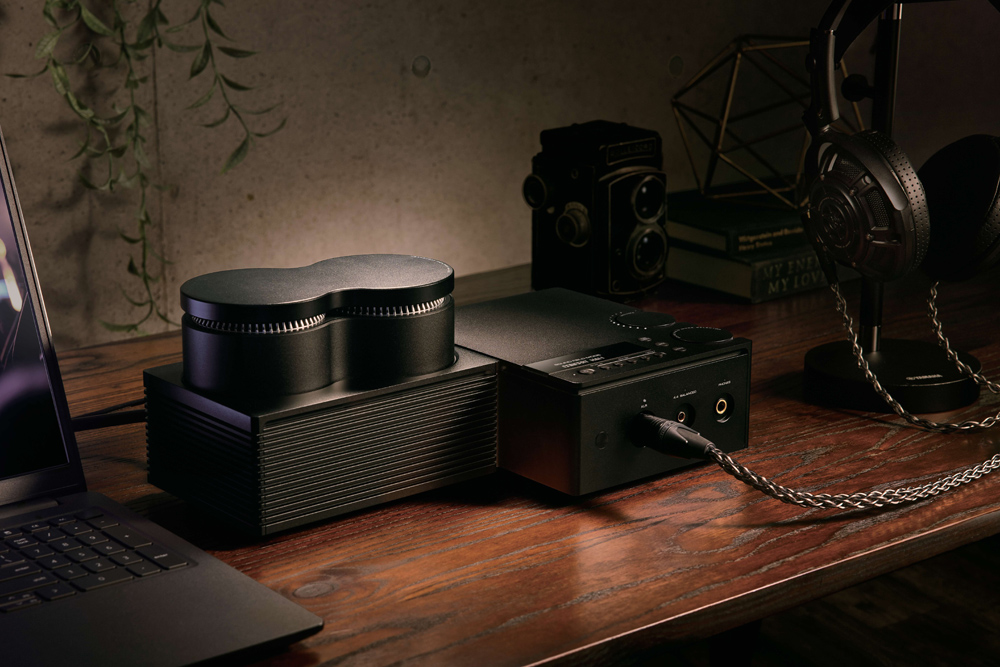
The growth of the personal audio space has yielded an abundance of options spanning diverse technologies and product types that encompass all price points. Like the audio industry at large, boundaries have been freed, and even pushed as far as the laws of physics allow, and brands have been increasingly motivated to deliver a wider selection of top-end products as vanguards to the state-of-the-art. One of the newest entrants is Yamaha’s upmarket YH-4000, which showcases the company’s latest headphone technologies. For this review, I pair them with the uniquely styled HA-L7A headphone amplifier, itself a remarkable multi-function specimen from that closely associated corner of the market. Yes, the high-end headphone space has been a powerful audio market driver. Can this high-technology duo launch towards the sun at an escape velocity greater than the speed of… sound?
UnOrthodox
The high-end YH-4000 headphones are a unique open-back design which enjoy the fruits of trickle down technologies derived from the flagship YH-5000SE. The YH-4000 feature Yamaha’s proprietary ‘Orthodynamic’ Planar Magnetic driver technology and a mix of premium advanced materials, such as an ultra-lightweight magnesium body frame, across the headphones’ construction architecture.
First introduced on the classic HP-1 in the mid-1970s, Yamaha’s Orthodynamic driver technology has been refined for the new YH-4000. Inspired by the flagship YH-5000SE, the YH-4000 eschews the sound absorbing materials employed in its stablemate, a strategy that has allowed Yamaha engineers to modify and fine-tune the drivers to suit the new model.
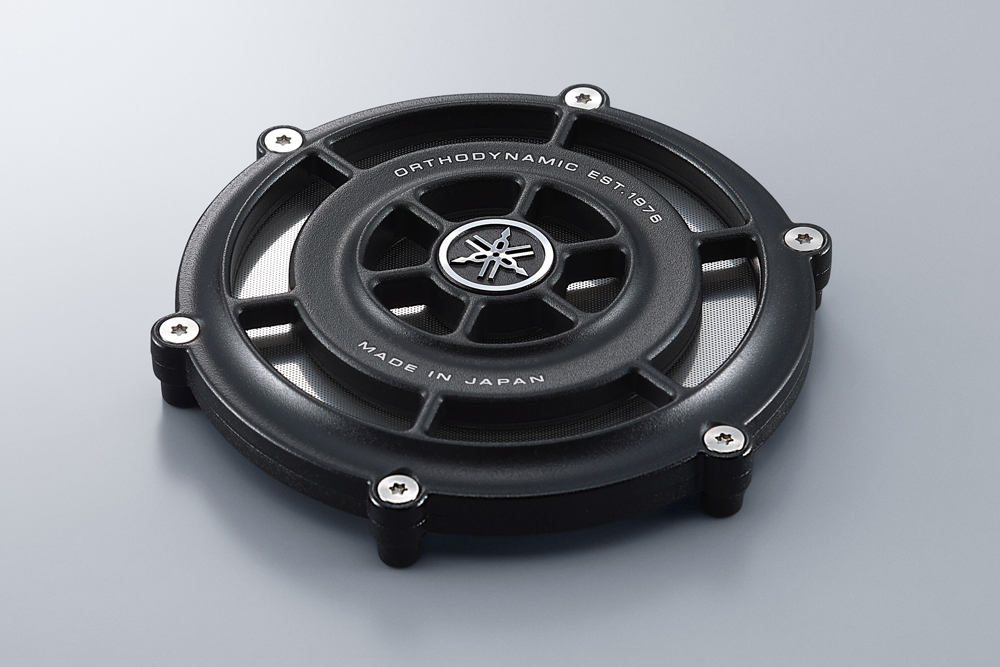
The Orthodynamic drivers feature ultra-lightweight, thin-film diaphragms flanked by “micro-perforation” air dampers designed to control excursion, resulting in claimed improvements in distortion-free dynamic expression. Positioned on both sides of the ultra-thin diaphragm, conductive coils feature finely corrugated “wave-like” patterns across their surface, with micro-perforation dampers flanking each of the diaphragms’ sides. The design elements combine to provide expressive dynamic contrasts coupled to low distortion. A PET mesh filter is said to precisely regulate internal housing pressure resulting in a “dense midrange and tight, punchy low-end”. An “arch-shaped protrusion” is employed as a reflector said to improve signal accuracy.
The high-rigidity, yet lightweight, design of the magnesium frame open-back architecture is engineered to aid the thin-film driver to perform at its best. This is achieved by excellent airflow and the elimination of resonances and vibrational distortions that could arise from reflected back waves within the overall structure.
The oversized earcups’ internal acoustic volume assist in extending the low frequencies. The headphone ‘cups’ are supported by a dual-layer leather and aluminium headband attached to a tilting/swivel stepless mechanism designed to offer excellent comfort, convenience and durability. The earpads have been exclusively designed for the YH-4000 and are said to provide resistance to heat and superb comfort for long listening sessions. They feature high quality artificial suede and PU leather. Perforations on the earpad’s leather outer edges provide ventilation and added comfort while also enhancing sound performance.
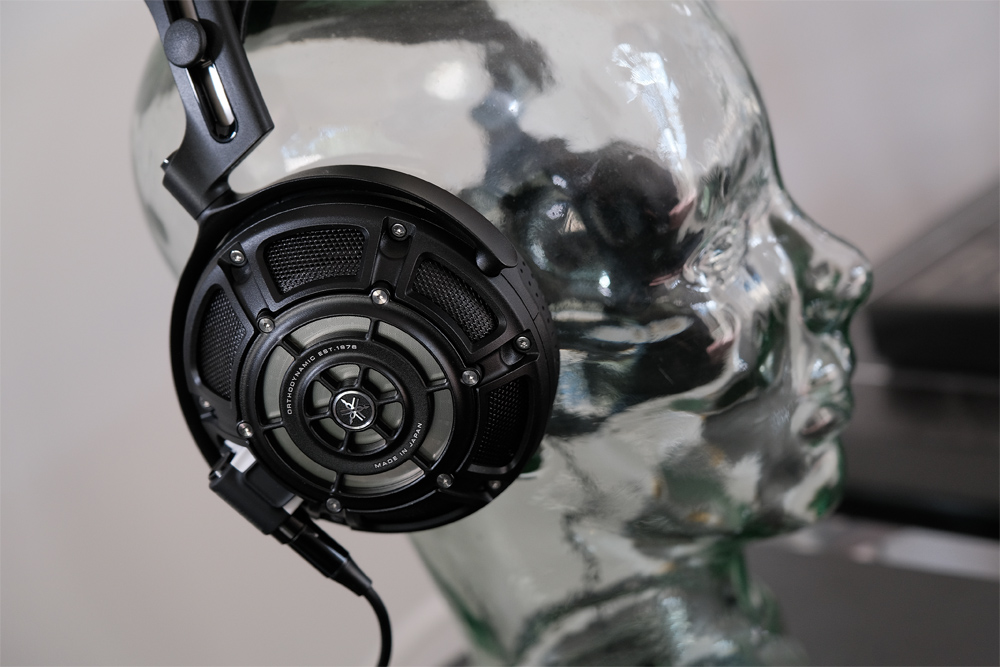
Yamaha includes a set of matching accessories with the YH-4000 including a premium OFC (Oxygen-Free Copper) silver-coated cable and a protective semi-hard carrying case. The YH-4000 is fully hand-assembled by highly skilled craftspeople in Yamaha’s Kakegawa facility (also where Yamaha flagship grand pianos are created).
The YH-4000’s supplied specifications include a frequency range between 5 Hz and 70 kHz, a Sensitivity of 97 dB/mW (at 1 kHz), and an Impedance of 34 ohms (at 1 kHz) with an approximate weight excluding the headphone cable of 320 grams (11.29 oz).
Head High
A unique industrial design graces the distinctive HA-L7A headphone amplifier. In fact, this is no mere amp. The unit features a high quality digital-to-analogue converter, has both balanced and unbalanced preamplifier outputs, a variety of input and output options, and a Texas Instruments DSP engine providing several sound tailoring settings. In addition, Yamaha has applied its proprietary floating and balanced amplifier technology as used across a number of the company’s high-end amplification products, including the flagship M-5000 power amplifier (review here).
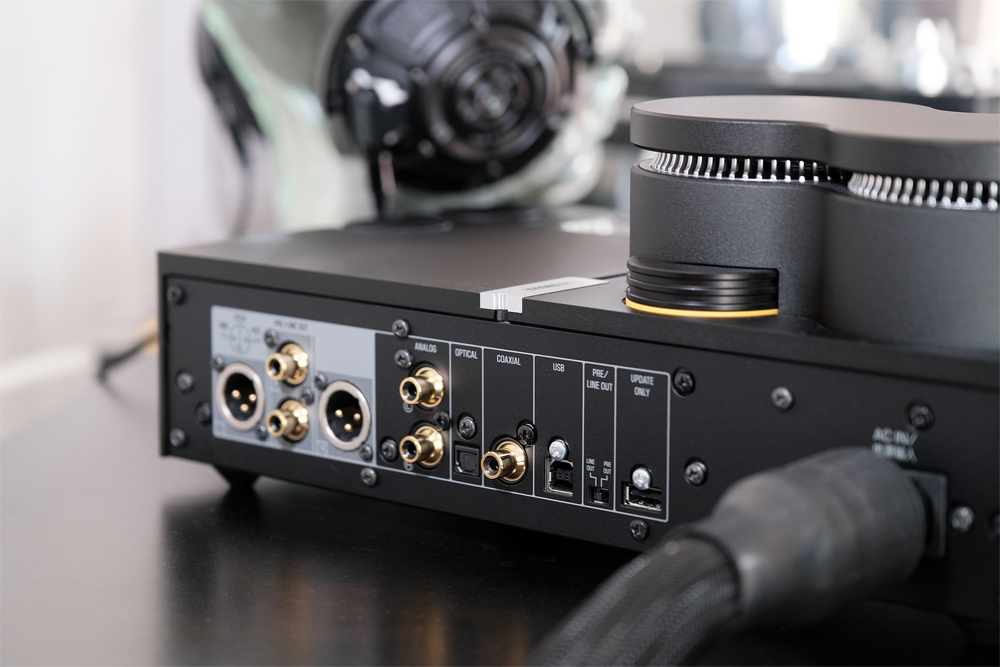
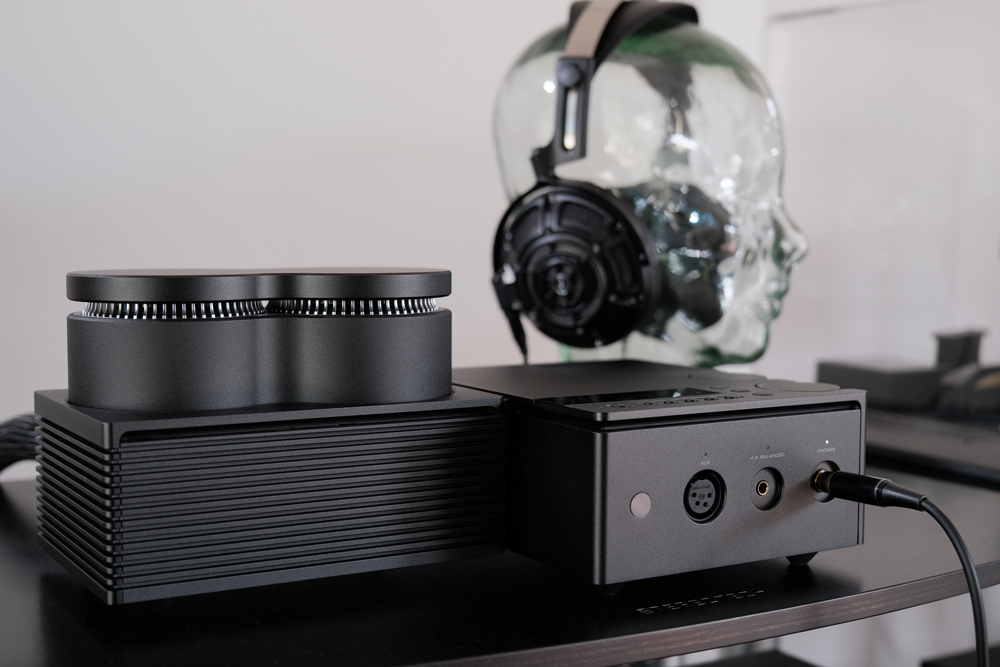
I’ll hit the connectivity first. Around the back and from left-to-right, you’ll find the preamplifier outputs catering to both balanced XLR and unbalanced RCA followed by a single unbalanced RCA analogue input. Next are the digital inputs encompassing optical Toslink, coaxial RCA S/P-DIF, and a USB-B port for audio (Yamaha Steinberg circuit). A small switch toggles between Line-Out and Pre-Out (for preamplifier to power amplifier hook-up). Next to that are a USB-A port for software updates (version 1.01 at the time of this review) and a standard IEC socket. The front panel sports a four-pin XLR and 4.4 mm plus 6.5 mm headphone output sockets (each output features a small white LED to indicate its operation).
The HA-L7A’s in-built digital-to-analogue converter features the highly regarded ESS Technologies ES9038PRO flagship DAC mated to the same company’s ES9842PRO 32-bit high-performance analogue-to-digital converter (ADC). Both circuits sport independent power supplies and grounding architectures. Playback resolutions encompass up to 32-bit/384 kHz PCM and DSD256 natively (11.2 MHz).
The headphone amplifier’s rated output is given as 1000 mW at 1 kHz on an impedance of 32 ohms with 0.01% Total Harmonic Distortion (THD) for both balanced and unbalanced modes. The Frequency Response of the headphone section is from 4 Hz to 80 kHz -3dB. The Signal-to-Noise Ratio (SNR) is said to be under 120 dB.
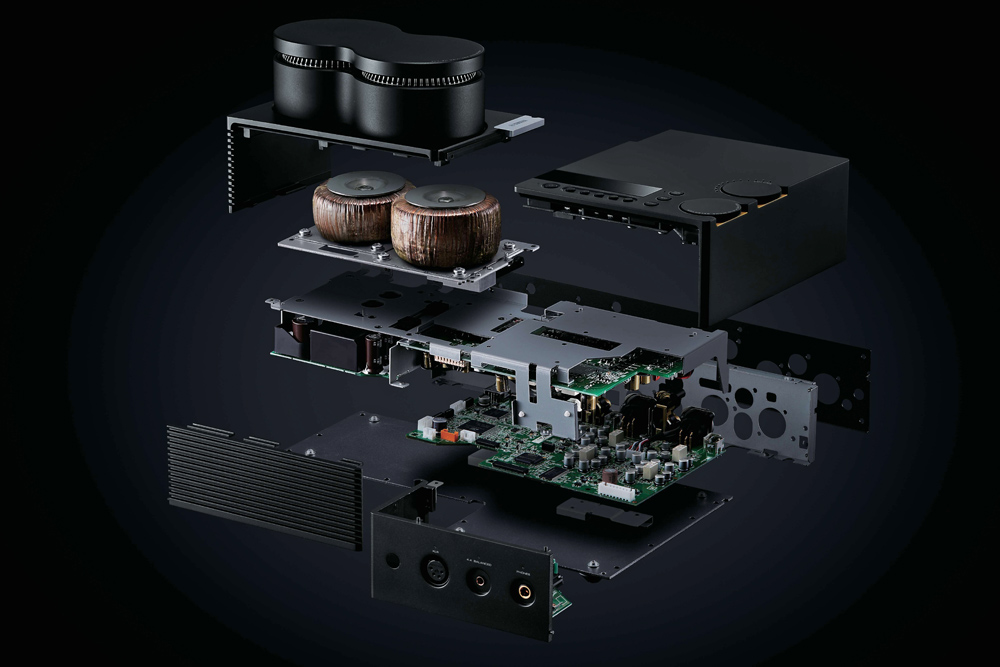
The HA-L7A’s presents a truly unique ‘L’-shaped form, with the longer, slimmer section supporting atop it a vented figure-eight-shaped enclosure. Housed within are twin custom toroidal transformers, one each for the preamplifier and amplifier stages. The transformers feature bi-filar winding, a strategy that is said to minimise and stabilise voltage variations. The remainder of the power supply and its high quality capacitor bank are placed just below. The shorter, bulkier section of the ‘L’ contains the controller/switcher section along with the DAC, DSP, general electronics and associated circuitry. The HA-L7A’s chassis is superbly stiff, featuring an 8 mm top plate, 2 mm steel sides, and thick front and double rear panels. Oh, and the whole shebang sits on high quality bespoke metal footers. Vibration control has been treated seriously.
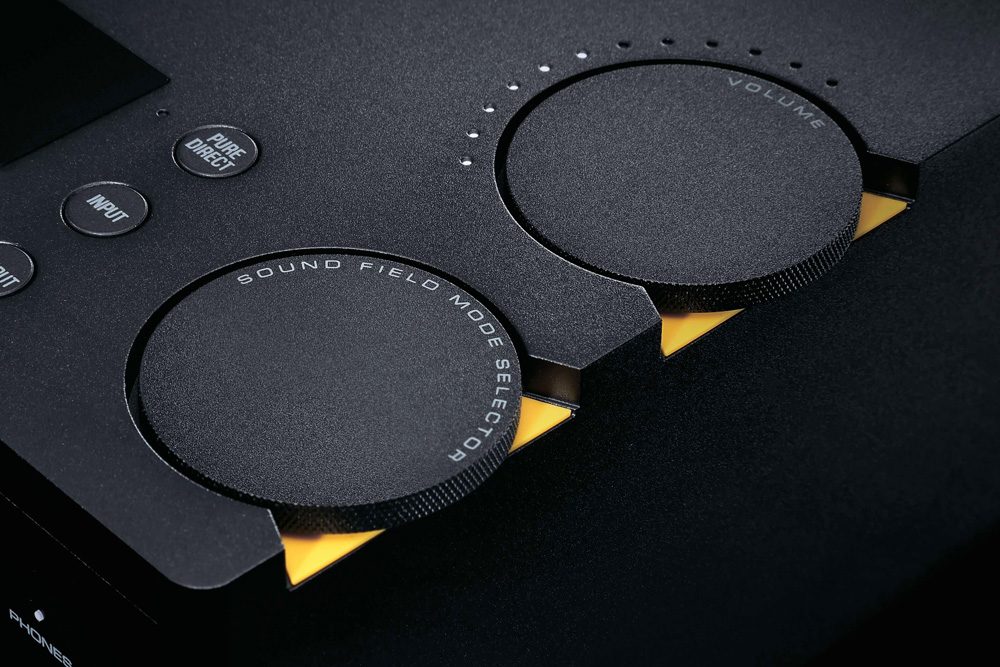
The HA-L7A’s top panel is where the action is. On the right-hand-side, towards the unit’s edge, are two large rotary knobs, the top-most being the volume control which is flanked by a series of small white LEDs acting as markers for the volume position. The second knob toggles between the various DSP modes (‘Sound Field’ modes as Yamaha calls them) which include Straight (no digital effect), Cinema, Drama, Music Video, Concert Hall, Outdoor Live, and BGM. This last mode is a background music mode which localises the music as though it’s emanating outside the listener’s head, as Yamaha puts it, employing the company’s proprietary ‘Head-Related Transfer Function’ high-definition technology.
While most of my listening was done via the Pure Direct mode for utmost accuracy, briefly trying the various digital modes provided both subtle and not so subtle alterations to the sound. The effects aren’t brutal music-destroyers. In fact, they can provide variations to the theme that can be enjoyed as standalone alternatives. They’re virtual simulations reflecting the descriptor. Cool tricks to be enjoyed from time to time and where the mood takes you.
An OLED display window serves as the status and function selector. When playing music, it’s blacked out until a change in volume (a minus X dB is displayed) or a function or menu are activated. Of course, the OLED display serves as a visual navigation guide through the various menu pages which include the DAC filter options (can be set individually per input), DAC ‘Lock Range’ for reducing jitter, gain levels for the headphones and Line-Out/Pre-Out outputs, volume limitation, balance L/R, and much more.
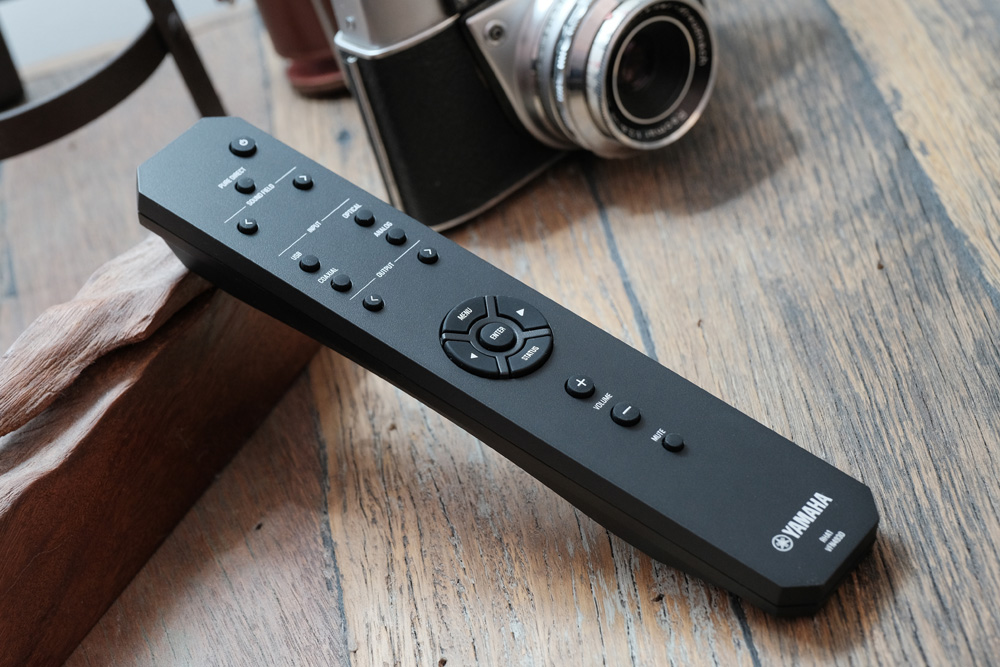
In addition to the display, a set of buttons provide the interface for the menu navigation. Aside from the soft-switch on/off button, the control buttons include Status (display info switcher), Left toggle, Enter, Right toggle, Menu selection, Pure Direct activation, an Input selector, and an Output selector. The HA-L7A is packaged with a remote control which mirrors the unit’s full suite of functions, providing access to all features and operations.
The HA-L7A’s sophisticated circuit design is the fruit of engineer Ryota Sato while the advanced DSP design was created by Yusuke Konagai. For the YH-4000, Yuta Ito was the acoustic design engineer, while Kazuki Kashiwaze was responsible for product design. Both design teams crafted the YH-4000 and HA-L7A with mindful attention to Yamaha’s ‘True Sound’ philosophy. For further design, engineering, and company philosophy insights, check out my Yamaha True Sound feature here. I also conducted video interviews with key Yamaha personnel on YouTube; Part 1 here and Part 2 here.
Can to Can
I found operating the HA-L7A a real pleasure. The unit is built superbly, inspiring confidence through its user-intuitive control layout coupled to the operational and settings menu efficiency. It’s an overall flawless user experience. Ditto for the YH-4000s which also absolutely reek of quality design and intelligent engineering.
I connected the 432 EVO AEON server/streamer to the HA-L7A’s USB audio input and ran Roon. No issues with connectivity, with music quickly flowing through the YH-4000s without a hitch. I compared the YH-4000s with my in-house reference Fischer Audio Kennerton Magister, as well as Sony WH-1000XM5, an older set of Bowers & Wilkins P7 and KEF Space One (unfair contrasts, due to their age and price points, but worthwhile just for comparisons purposes), and Mitchell & Johnson HP1 hybrid electrostatic headphones.
By the way, I experimented with the various filters on the HA-L7A, with the final two favourites being ‘Fast Linear’ and ‘Fast Minimum’. So, take those two as the final filter configuration for the rest of the review process. Also consider that my YH-4000 audition was conducted with the HA-L7A as the amplification driver, as they form a natural partnership.
The Yamaha and Kennerton Audio headphones were head and shoulders above the rest in all areas, bar none. Then pitting the two superior headphones against each other provided me with excellent points of comparison. The YH-4000s offered deeper and more solidly punchy low registers while, in comparison with Kennerton Magister, recessing vocals a tad. Ergo, the Kennerton Magister’s bass was a bit lighter (still way ahead and more powerful than the other headphones I has at hand) and presented the vocal range in a more forward fashion, providing the short-term impression of somewhat more detail within that range. Listening deeper proved that, while marginally more recessed, the YH-4000s delivered just about equal amounts of low-level detail.
It’s actually a well-judged sound presentation, offsetting a hint of lushness with a dousing of nuanced resolution and scalpel-sharp separation. The very subtle midrange warmth gave John Martyn’s vocals on “Glory Box” from his The Church With One Bell album, a sense of full-bodied presence while preserving the clarity and intelligibility of the lyrics. What’s more, the track is grounded with a low frequency underpinning which the YH-4000 handled with excellent control, weight, and depth.
Ditto for Sally Timms’ “Corporal Chalkie” from her In The World of Him album where her precise vocals were well separated from the distorted guitar. Towards the end of the track, the punk-influenced buzz-and-fuzz of the guitar solo had stunning impact, both in terms of immediacy and sheer dynamic power. The drummer’s cymbal-play accents sounded clear, extended and metallic, just as they should when reproduced via a precision device.
While the YH-4000 headphones aren’t fussed about music genre, they really excelled with Jazz and large orchestral works. It was an immersive experience that offered open vistas into large soundfields and provided the illusion of many artists playing in unison, creating a single, cohesive expression of music. When it came to jazz instrumentalists, I listened to iconic recordings from Miles Davis, John Coltrane, Thelonious Monk, Jaco Pastorius, Charles Mingus and many others, all portrayed with faithful precision and listener engagement. And boy, was Pastorius’ bass a delight to hear… Big orchestral works from Beethoven, Brahms, Vivaldi, Wagner and others were equally rewarding and far from that ‘in-your-head’ experience often associated with closed-back designs.
There’s no doubt that the YH-4000s are superbly transparent, informative and thoroughly adept at presenting the minutest of details. It’s an open sound (yes, I know, it’s an open-back design), quite sweet and smooth across the highs and mids, and a superbly… comfortable listen. I’m talking about comfort regarding both sonic fatigue (basically non-existent), and physical on-head/over-ear comfort (you’ll forget you’re wearing them). The YH-4000s draw you into the music in a way that turns a mere listening session into extended musical events. And that’s what music listening is all about, right?
For the second leg of my audition, I operated the HA-L7A as a preamplifier via its balanced XLR outputs to the balanced XLR inputs of my Gryphon Audio Antileon EVO (and also the new Antileon Revelation, in for review) which drove the Wilson Audio Alexia V.
Coupled to the cleverly executed circuit design, the HA-L7A’s XLR outputs delivered a clean, neutral, and well-controlled sound. Transient edge-of-note attack was exemplary, infact. While it may not quite reach the ultimate bass weight, or the ultimate dynamic expression of a dedicated full-sized solid-state preamplifier (optimised to do one thing), the margin between them would not be night and day. This is a clear indication of the calibre of the HA-L7A when operating in this configuration.
Conclusion
Yamaha’s engineers have come full circle and perfected the Orthodynamic planar magnetic principle with modern materials and techniques. The YH-4000 joins the YH-5000SE top-liner headphones as the latest iteration of the concept. This is a polished technology which provides a point of difference to the legions of over-ear headphone designs that, overwhelmingly, employ variations of conventional headphone drivers coupled to either open-back or closed-back designs.
Further, in what is undoubtedly a naturally perfect match, the HA-L7A headphone amplifier ranks among the finest of its kind this reviewer has heard… and seen. It’s immaculately constructed, operates with the precision of a Swiss watch, is feature rich, distinctively styled, and delivers sonic performance totally befitting its flagship status.
Yes, these two are individually exceptional, but pair the YH-4000 Orthodynamic headphones together with the HA-L7A headphone amplifier/DAC and you’ve got a dynamic duo that, without question, will please even the most uncompromisingly pedantic personal audio enthusiast.
… Edgar Kramer
This email address is being protected from spambots. You need JavaScript enabled to view it.
Associated Equipment
- Speakers — Wilson Audio Alexia V, Axis Loudspeakers VoiceBox S (nearfield monitor), Vermouth Audio Little Luccas Mk.II Limited Edition, Atacama stands
- Amplifier — Gryphon Audio Antileon EVO
- Preamplifier — Supratek Cortese, Totaldac d1-triunity (periodically, direct to amplifier)
- Sources — Digital: 432 EVO Aeon Mk.3 Reference Music Server/Roon Core, Yamaha CD-S2100 transport, Totaldac d1-triunity DAC. Analogue: Transrotor Crescendo with Konstant Studio controller, Reed 1X Tonearm with upgraded internal wiring, Shelter Harmony cartridge, The Funk Firm Houdini cartridge decoupler, Supratek Cortese & REDGUM Audio RGPH2 phono stages
- Processor — DEQX PreMate (part of arsenal/casual use)
- Cables — VYDA Laboratories Orion Silver Reference HFC IC and speaker cables, Cerious Technologies Lumniscate loom, PSC Audio custom design XLR, Vermouth Audio Reference loom, Tubulus Concentus USB
- Audio Rack — SGR Audio Statement MODEL V, Aspire Audio Belgravia amplifier platform (customised for Gryphon Audio Antileon EVO), Stereotech Aluminar Dark 3-tier rack
- Acoustic Treatment — Vicoustic Multifuser Wood, Wavewood Ultra, Cinema Round Premium and Super Bass Extreme
- Miscellaneous — Silent Angel Bonn N8 Pro network switch, GigaWatt PF-1 EVO power strip, Les Davis Audio Viscoelastic CLD discs, Voodoo Cable Iso-Pods, Bocchino Audio Mecado, Secret Chord Analogue Record Restore, plus miscellaneous accessories
Yamaha YH-4000 Headphones & HA-L7A Headphone Amplifier
Price: YH-4000 AU$3999, HA-L7A AU$6999
Australian Warranty: Four Years + One Year After Registration (Purchased via Australian Authorised Dealers)
Australian Distributor: Yamaha Music Australia
+61 1800 805 413
www.yamaha.com.au
Yamaha Corporation
10-1, Nakazawa-cho, Naka-ku
Hamamatsu Shizuoka 430-8650, Japan
+81 (53) 460-2211
www.yamaha.com