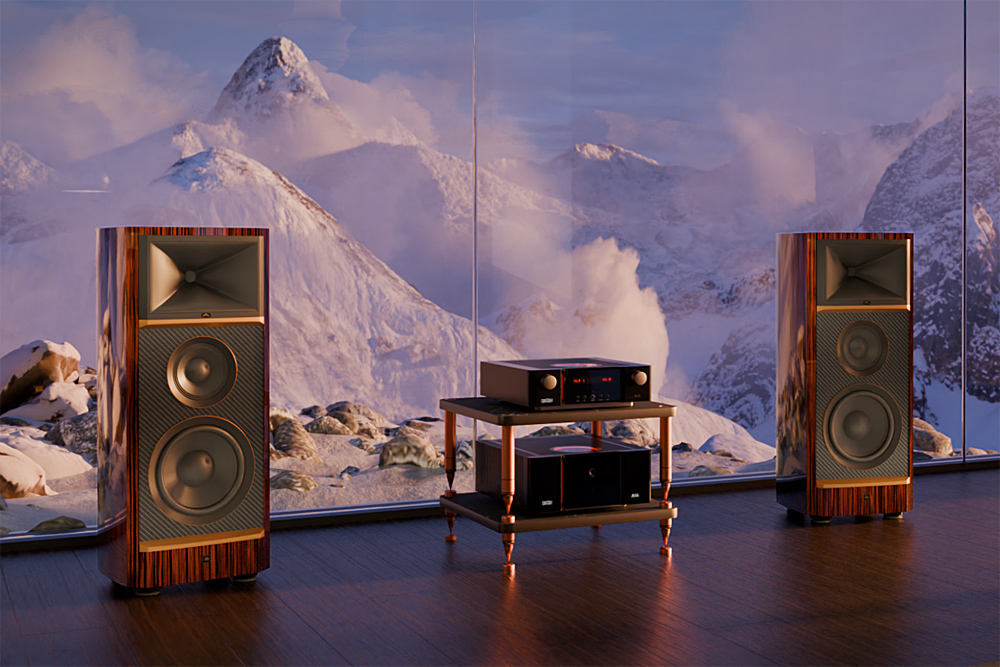
If you were to associate a highly respected loudspeaker company with pioneering design, truly innovative engineering and a continuous lineage stretching back to the very spawning of loudspeaker design across sound reinforcement, studio monitoring, and high-end consumer audio, the poster child would be the venerable JBL. Sure, there were contemporaries like Altec Lansing, Electro-Voice, and Jensen with even earlier beginnings, but those trailblazers have, alas, morphed away from the high-end audio space. Meanwhile, across the pond, early achievers included Celestion, Tannoy, and Wharfedale. Back States-side, JBL became synonymous with the ‘West Coast American Sound’. More recently, the company even earned an Academy Award for Technical Achievement. In 2026, the Oscar winner announces the new Summit series. Here, we take a look at the current flagship, the Makalu loudspeakers.
Not Just Bloody Loud
OK, let’s get the clichés, the generalisations, and the entrenched tribalism out of the way from the jump (I also address this in my ‘Lead-In’ YouTube video here, among other things). In my opinion, some audio tribespeople have pigeon-holed and perpetuated the stereotype of JBL speakers possessing a particular sound, an exaggeration of that ‘West Coast American Sound’ I refer to in the intro. The association has long been with a somewhat tizzy top-end, a mildly recessed midrange, and a big, extroverted bass.
Of course, accurate or not, such a deep-rooted mindset ignores the fact that, like everything else, JBL as a company has evolved through generations of highly acclaimed loudspeakers. Sonic signatures have changed while measuring tools, driver technologies, crossover components, cabinet materials have all advanced over the company’s 80 years of excellence in loudspeaker design. In fact, that 80th milestone is being celebrated this very year, and the new Summit line stands as one of the beacons marking the occasion.
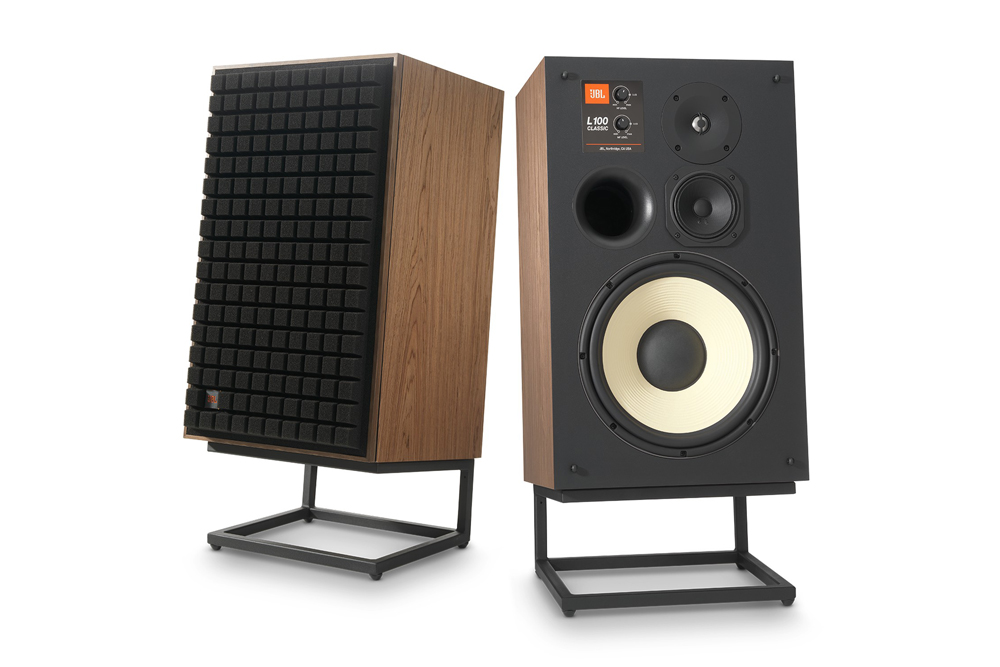
And talk about past landmarks… so, so many of them, converging the studio with the discerning music loving consumer. I mean, really, who could, in their right mind, possibly undervalue the mighty 4350, a classic colossus capable of tremendous scale and devastating power. Another one of my favourites is the stunning L250, that pyramidal gem which departed from previous JBL designs and delivered spatial qualities to die for. Of course, the original L100 Century from 1970 is iconic (now reimagined in the recently released Classic L100 and the soon-to-come celebratory L100 Classic 80). Nay-sayers be gone, yay-sayers unite!
So, the new Summit line is JBL’s latest push to create loudspeaker systems aimed squarely at the high-end market, ergo the series’ ‘Reference’ label. At this stage, the range includes a large 2-way standmount, a 3-way 10 inch (250 mm) floorstander, and at the top-of-the-line, as it is at the time of writing at least, a 3-way 12 inch (300 mm) large floorstander, the latter, of course being the subject of this review.
Quite aside from currently being audio’s worst kept secret, JBL does hint at larger 15 inch-based designs to come purely based on its website’s phrase pointing at Makalu being “the flagship of the Summit Series for the 12-inch (300mm) woofer category”.
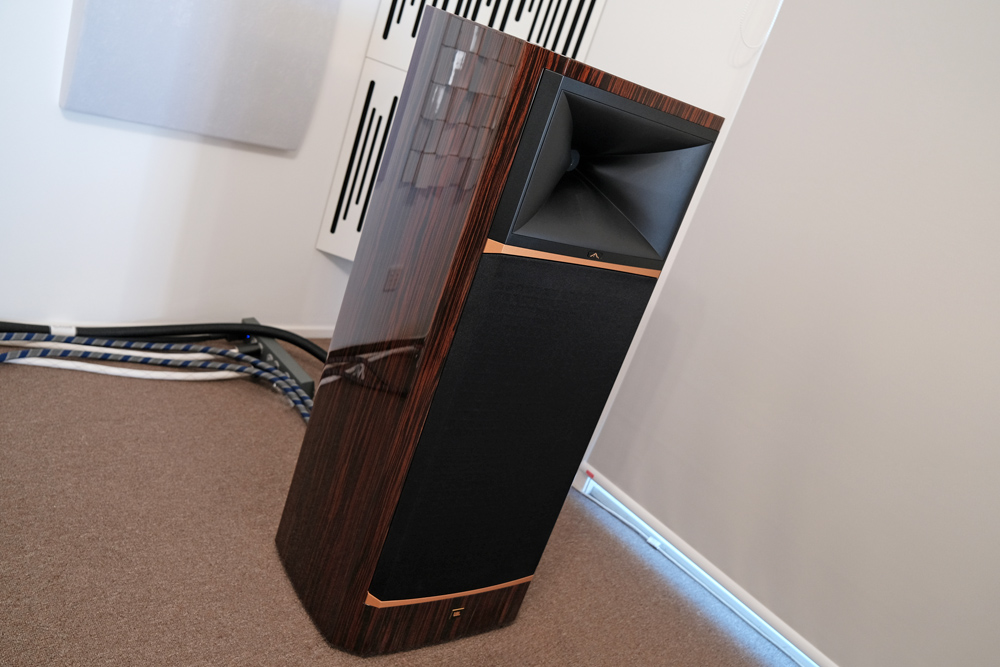
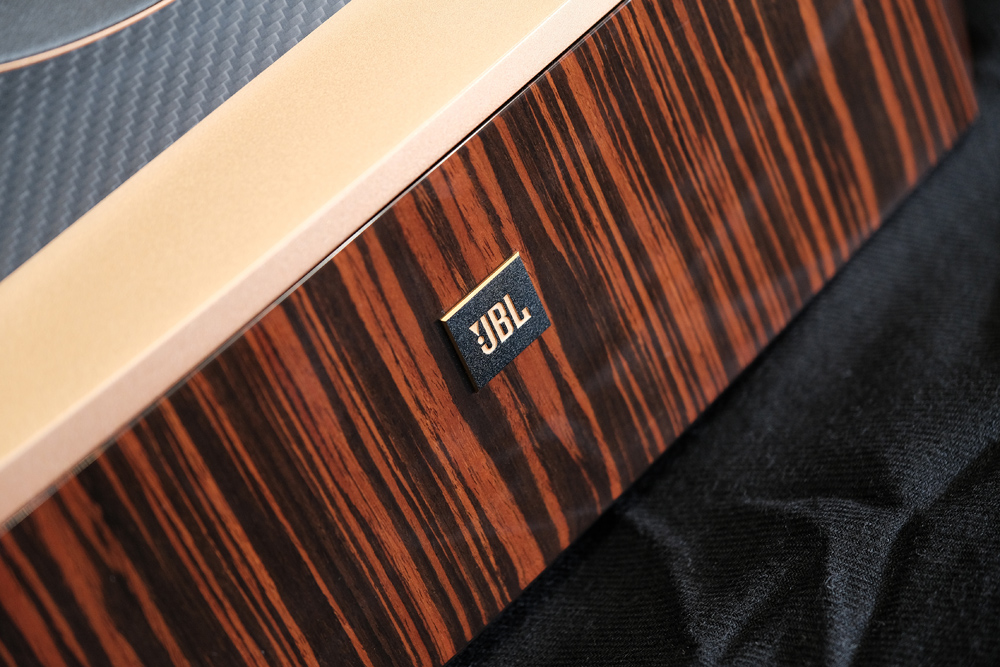
As part of the the consumer top line, Makalu speakers are aesthetically elegant and beautifully finished. Our pair came in immaculate gloss Ebony featuring gold trim accents (gloss black with platinum trim is also available). A further visual enhancement is the carbon fibre-veneered baffle, which houses the three-driver configuration and also serves to provide front panel reinforcement and vibration control. The cabinets are gently angled and subtly chiselled around the side panels towards the corners’ edges where they meet the speakers’ front and rear.
The heavy, well-braced and damped enclosure (JBL refers to the bracing scheme as Internally Offset Multi-Braced) sits on custom IsoAcoustics GAIA Neo isolation feet which allow level adjustment. In my experience, the GAIA concept is exceptionally accomplished at providing low frequency performance improvements.
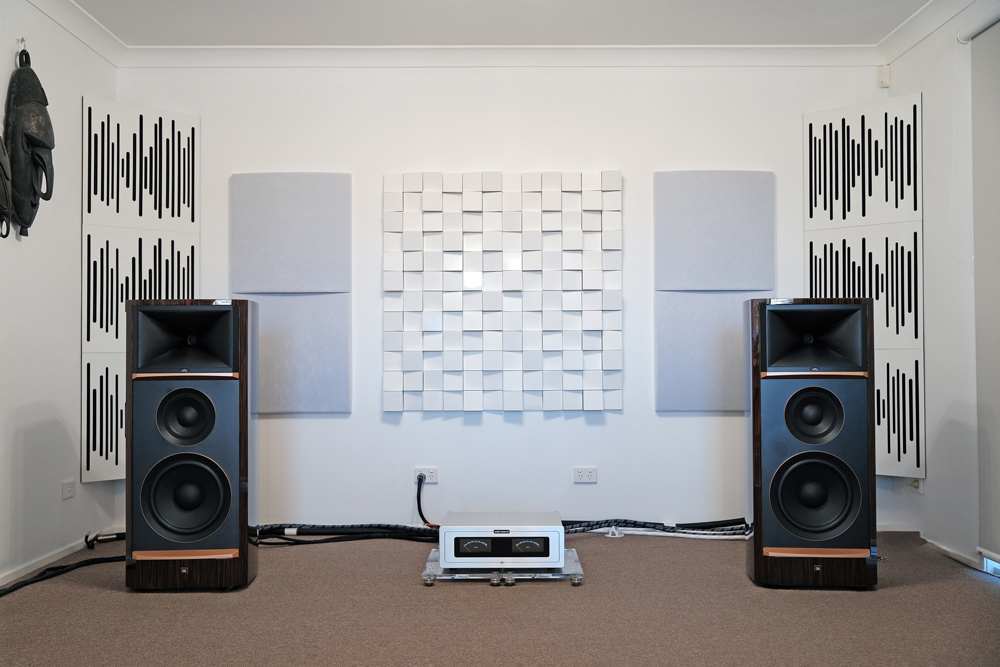
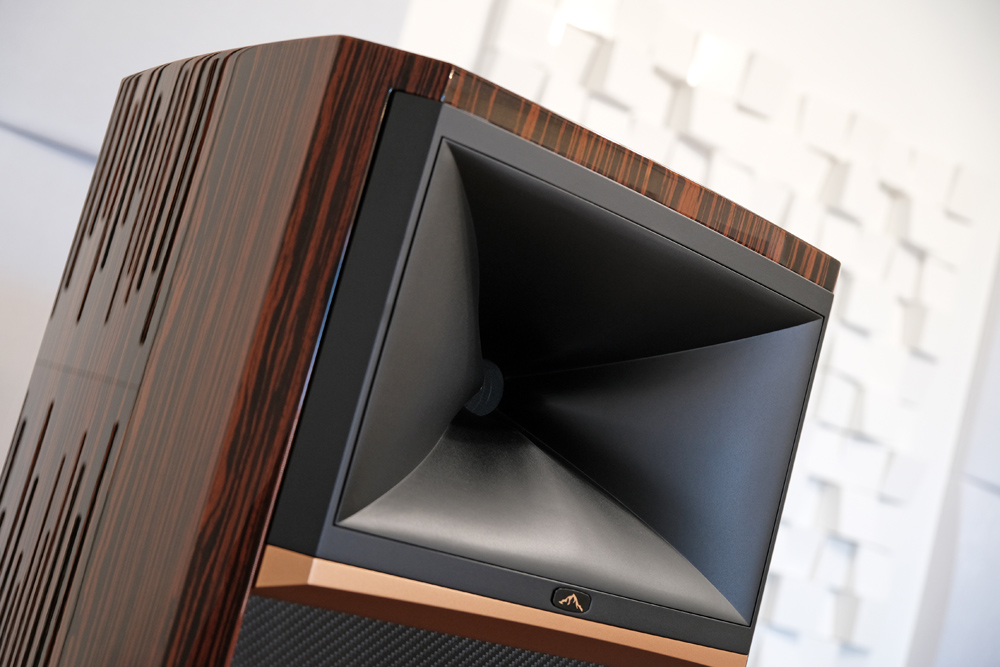
As attractive as Makalu presents visually, it’s the all-new driver technology JBL has applied to the design that, once again, highlights the company’s innovation. Handling Makalu’s high frequency output is the D2830K, a 3-inch (75mm) compression driver featuring dual ‘Annular Ring Teonex’ diaphragms and dual motors. The tweeter is mounted in its own sealed cabinet and sits within a newly developed Sonoglass High-Definition Imaging (HDI) horn. The horn’s flare is profiled specifically for efficiency and excellent high frequency dispersion.
The midrange is handled by a new 8-inch (200mm) Triple-Layer Hybrid Carbon Cellulose Composite Cone (HC4) mid-bass driver, also placed in a dedicated sealed enclosure. As its description states, HC4 is a hybrid cone combining carbon fibre with paper pulp which is coupled to a treated cloth ‘Accordion-Edge’ surround. Its architecture incorporates dual inverted spiders and a 2.5 inch voice coil within a large underhung neodymium magnet system, all ingredients promising well-controlled diaphragm and driver excursion.
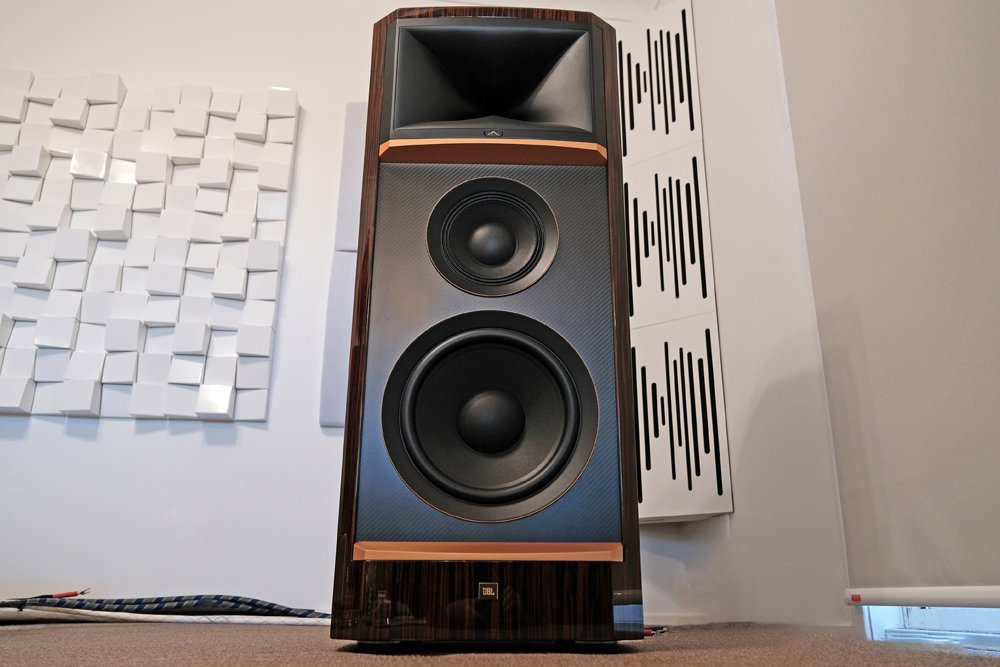
The low frequencies are delivered by a 12 inch (300mm) HC4 woofer which, again, means it’s a Triple-Layer Hybrid Carbon Cellulose Composite Cone terminated via a ‘Half-Forward-Roll’ surround. The motor system features a massive ferrite magnet, dual inverted spiders and a 3 inch voice coil. Again, we’re seeing considerable engineering efforts to control driver excursion and even higher power handling. The woofer is supported by dual flared reflex ports on the cabinet’s rear panel.
JBL engineers have dedicated significant efforts to design the ‘Acoustically Symmetric’ 3rd- and 4th-order 3-way crossover network for Makalu. In an effort to minimise potential distortions associated with Electro-Static Resistance (ESR), the crossover network employs a bank of smaller high quality MultiCap capacitors rather than the more common approach of using a small number of larger ones. Increased power handling is also a side benefit of the capacitor bank. The crossover points are given as 285 Hz and 1100 Hz.
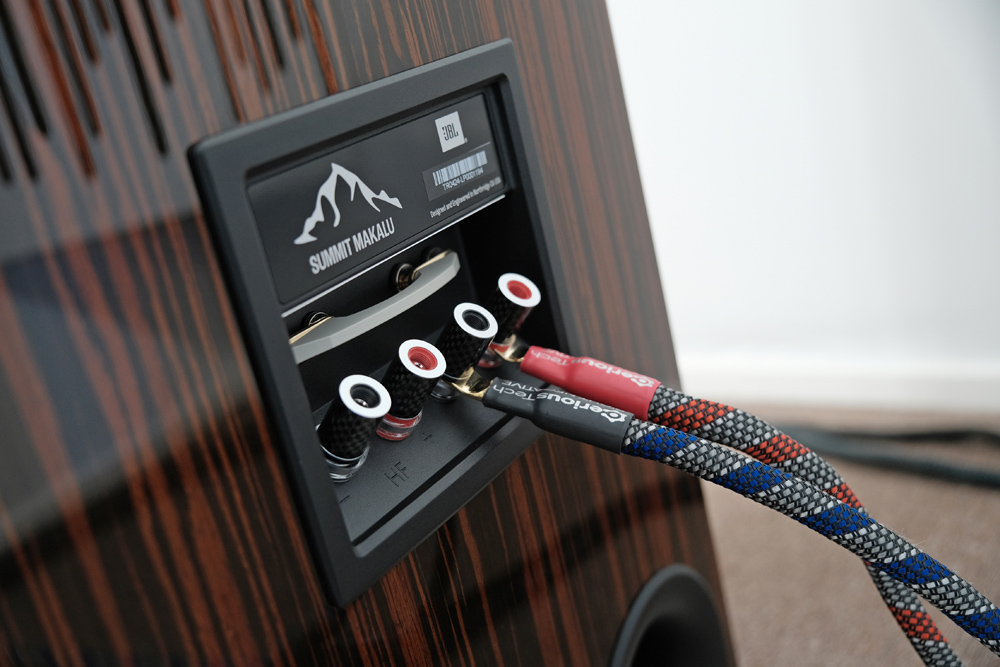
Makalu accepts single-wiring, bi-wiring and bi-amping via the high quality speaker binding posts (rhodium plated, silver coated, oxygen-free copper core) with the switch between single- and bi-wiring activated via a linking metal bracket which couples or decouples the binding posts. No cable re-wiring needed.
The main Makalu speakers’ specifications are a Frequency Response of 23 Hz to 33 kHz +/- 6 dB, a nominal impedance rated at 4 ohms with a minimum impedance of 3.5 ohms at 79 Hz (reasonably benign amplifier demand), a sensitivity of 88 dB (2.3 volts at 1 m), and a recommended amplifier power of 25 watts minimum and 300 watts maximum. Maximum SPLs are said to be 113 dB.
Act of Defiance
In a contrarian act countering the narrow views once held by a small sector of audiophilia, the JBL Makalu delivers refined and delicate high frequencies that seamlessly couple to a lively and tonally correct midrange. The mids, in-turn, are expertly blended with that 12-incher which outputs superbly powerful, tight and nuanced low frequencies while achieving remarkable extension into the low Hertz regions with considerable amplitude.
A positive archetypal association with JBL speakers is their highly engaging and visceral presentation of rock music. Of course, I did not foresee any issues here, but I started off playing some heavy-hitting tracks I knew would test Makalu.
On Rage Against The Machine’s self-titled album, the explosive “Bullet In The Head” steadily builds until, towards the end of the track, the trigger hits black powder. Tim Commerford’s short bass solo was almost devastating in its unbridled power, depth and speed. Then as Tom Morello on guitar and Brad Wilk on drums unleash chaos, Zack de la Rocha closes the track with a detonating angst-yell, overlayed over the instrumental climax. One word: Wow!
For something completely different stylistically (play this LOUD), the title track of Puscifer’s Conditions Of My Parole album, punched hard through a very dynamic recording of the drum kit, in particular. The snare and kick drum were almost an assault on the senses while Maynard James Keenan’s (also from Tool and A Perfect Circle) vocals cut through with clarity. The track’s lyrics are both humorous and quite disturbing, as they’re meant to be, given the type of fictional character singing them (a shady antagonist who pops up as an unwelcome guest across several of the band’s videos and albums).
The low frequency pulses and the dexterously-played electric bass on “F Maj Pixie (Squarepusher Remix)” from GoGo Penguin’s RMX album (the jazz trio’s first go at a fusion of jazz and near-ambient electronica) were amazingly well rendered. The former sounded concussive while the latter was convincingly real. This is not an easy track to unravel, but the Makalu speakers jumped at the challenge. As did I.
The tone of the violin on Sarah Nemtanu on “Csárdás” on the album Gypsic was present and presented with excellent detail of rosin, string and the instrument’s body. When Nemtanu varies her technique, the Makalu tracks it without confusing the notes nor unbalancing the instrument’s tonal qualities.
Staying in classical music (even if Gypsic is a hybrid genre influenced by traditional eastern European music), the grandeur of large orchestral compositions was transfixing. For example, Tchaikovsky’s 1812 Overture, Op.49 on the Mercury Living Presence label was a model for spatial information with a super-dimensional soundstage and pin-point imaging. The orchestra was HUGE. And when those cannons kicked-in… man, the dynamics will floor you.
From modern jazz to the genre’s classics, the Makalu speakers were able to convey the complexities and musicianship subtleties without confusion, compression or congestion. On the staple-diet Wood album by Brian Bromberg, the Beatle’s cover “Come Together” is a lesson on dexterity and control of the upright bass. The string plucks are shockingly snappy while the instrument’s body and the notes’ depth were extraordinarily enjoyable.
On tracks where the band plays in unison, like on “Cantaloupe Island” from Jeff Goldblum’s The Capitol Studio Sessions, the piano, double bass, and saxophone are all individualised without disrupting the musical flow. On the same album, “Come on-a My House” Imelda May’s vocals are stupendously immediate and cohesive with the backing band, building a copacetic relationship between sultry-moody vocalist, the keyboards’ accents (is it a Hammond?), the depth-thrum of the double bass, and the rhythmic swing of the drum kit. Yes, this is a flawlessly engaging presentation.
Conclusion
Increasingly, we’re seeing higher numbers of speakers landing at this price point and beyond. Many come from smaller manufacturers aiming to make a statement while drawing on relatively modest budgets to create speakers that push the boundaries of what’s possible. Larger corporations share the same noble aspirations with, mostly, fewer financial constraints and bigger resource pools. Under the Samsung/Harman International umbrella, JBL is, of course, in the latter grouping.
Yet, it’s not only the relative freedom of more… elastic budgetary constraints that opens opportunities. It’s also JBL’s legacy as one of the world’s longest-running loudspeaker manufacturers, a company that has remained a consistent force in innovative engineering, particularly in terms of transducer technology.
The new Summit series and in particular Makalu, its current statement product, is JBL’s latest representation of that history. It showcases JBL’s newest drivers and crossover topology all housed within a beautifully constructed and properly rigid cabinet. The result is a loudspeaker system with tremendous output. Makalu is well balanced, dynamic, tonally textured and spans a frequency response with exemplary extension, especially at the lower frequencies.
With the Summit Makalu, JBL stamps a new footprint that carries the company’s enviable heritage into its latest chapter of engineering excellence.
… Edgar Kramer
This email address is being protected from spambots. You need JavaScript enabled to view it.
Associated Equipment
- Speakers — Wilson Audio Alexia V, Axis Loudspeakers VoiceBox S (nearfield monitor), Vermouth Audio Little Luccas Mk.II Limited Edition, Atacama stands
- Amplifier — Gryphon Audio Antileon EVO, Audio Research S-200 (in for review)
- Preamplifier — Supratek Cortese, Totaldac d1-triunity (periodically, direct to amplifier)
- Sources — Digital: 432 EVO Aeon Mk.3 Reference Music Server/Roon Core, Yamaha CD-S2100 transport, Totaldac d1-triunity DAC. Analogue: Transrotor Crescendo with Konstant Studio controller, Reed 1X Tonearm with upgraded internal wiring, Shelter Harmony cartridge, The Funk Firm Houdini cartridge decoupler, Supratek Cortese & REDGUM Audio RGPH2 phono stages
- Processor — DEQX PreMate (part of arsenal/casual use)
- Cables — VYDA Laboratories Orion Silver Reference HFC IC and speaker cables, Cerious Technologies Lumniscate loom, PSC Audio custom design XLR, Vermouth Audio Reference loom, Tubulus Concentus USB
- Audio Rack — SGR Audio Statement MODEL V, Aspire Audio Belgravia amplifier platform (customised for Gryphon Audio Antileon EVO), Stereotech Aluminar Dark 3-tier rack
- Acoustic Treatment — Vicoustic Multifuser Wood, Wavewood Ultra, Cinema Round Premium and Super Bass Extreme
- Miscellaneous — Silent Angel Bonn N8 Pro network switch, GigaWatt PF-1 EVO power strip, Les Davis Audio Viscoelastic CLD discs, Voodoo Cable Iso-Pods, Bocchino Audio Mecado, Secret Chord Analogue Record Restore, plus miscellaneous accessories
JBL Summit Makalu Loudspeakers
Price: AU$86,000
Australian Warranty: Five Years
Australian Distributor: Amber Technology
+61 (0) 2 9998 7600
www.ambertech.com.au
Harman Luxury Audio
400 Atlantic Street
Stamford, Connecticut 06901
United States of America
+1 888 691 4171
https://www.jbl.com/summit.html