




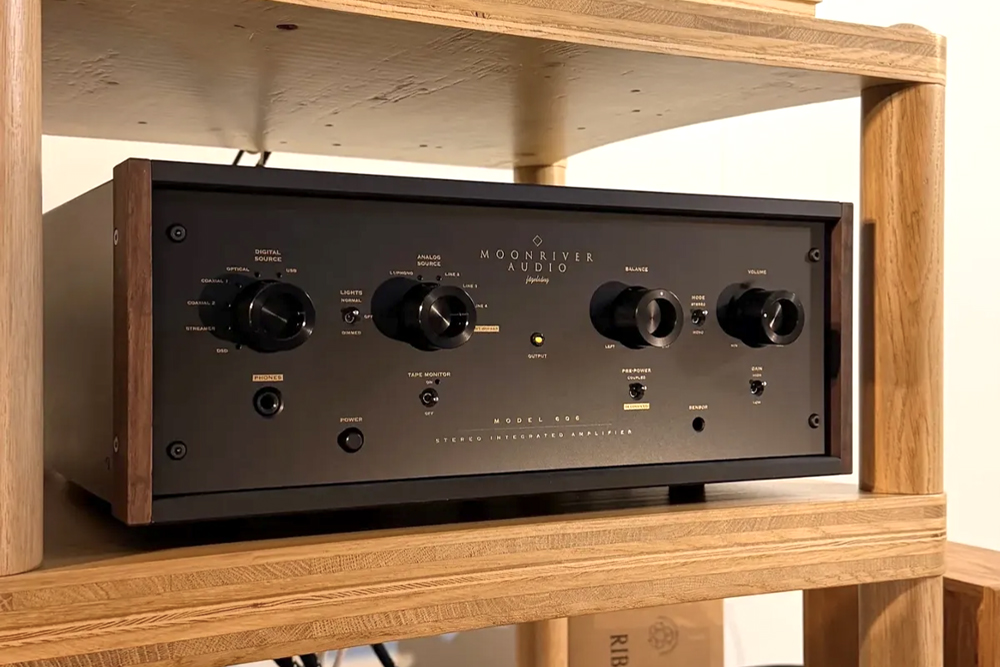
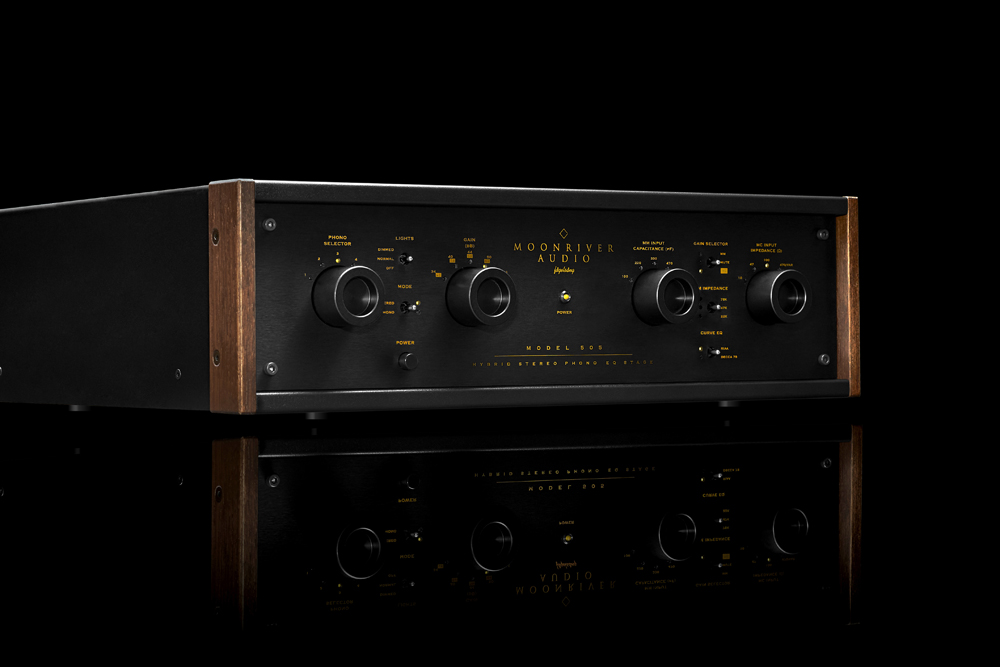
In for review is the multi-talented Moonriver Audio 505 Phono Preamplifier which is handmade in Sweden. With a wealth of features, this Swedish phono stage is able to accept four tonearms, allowing playback of many generations of black discs. Retro in looks, the Moonriver Audio Model 505 Phono is designed to allow the dynamics of the music to flow through, with easy adjustability at the forefront of the designer's goals.
Shooting for the Moon
Said designer is Greek-born Swedish resident George Polychronidis. A trained hi-fi service engineer, he also has a background in Industrial and Interface Engineering. Polychronidis began Moonriver Audio in 2015 and spent four years designing and testing the company’s first product, the Model 404, an integrated amplifier outputting 50 watts per channel. The name Moonriver comes from the movie Breakfast at Tiffany's, its soundtrack penned by Henry Mancini and Johnny Mercer.
According to the notes in the comprehensive Moonriver 505 Phono Preamplifier manual, Polychronidis owns 12 turntables, a further six more tonearms and 47 MC and MM cartridges! Here is the message on the internal PCB which states "This phono preamplifier was designed with audiophiles, record collectors and vinyl junkies in mind. All these colourful nuances, forgotten melodies and low level sounds that are lying hidden deep in the black, tiny grooves of new and old 33, 45 and 78 rpm records, will be revealed effortlessly. Sustainability, reliability and repairability are also included. Keep music alive!"
In the early 2020s work began and after two years of refinement the 505 was released to the market. The emphasis was to maintain dynamics, tonality and transparency. The Moonriver was also designed with ease of construction and repair/service using through-hole electronic components plus accessibility to the internal boards from the top and bottom panels.
The Moonriver 505 is described on the front panel as a Hybrid Stereo Phono EQ Stage, but the word hybrid may lead the reader to assume that it features valves and transistor components. However, this is incorrect. The hybrid moniker relates to the use of integrated circuits (ICs) and discrete solid stage circuits that, when properly designed, offer lifelike drive and dynamics not available from ICs alone.
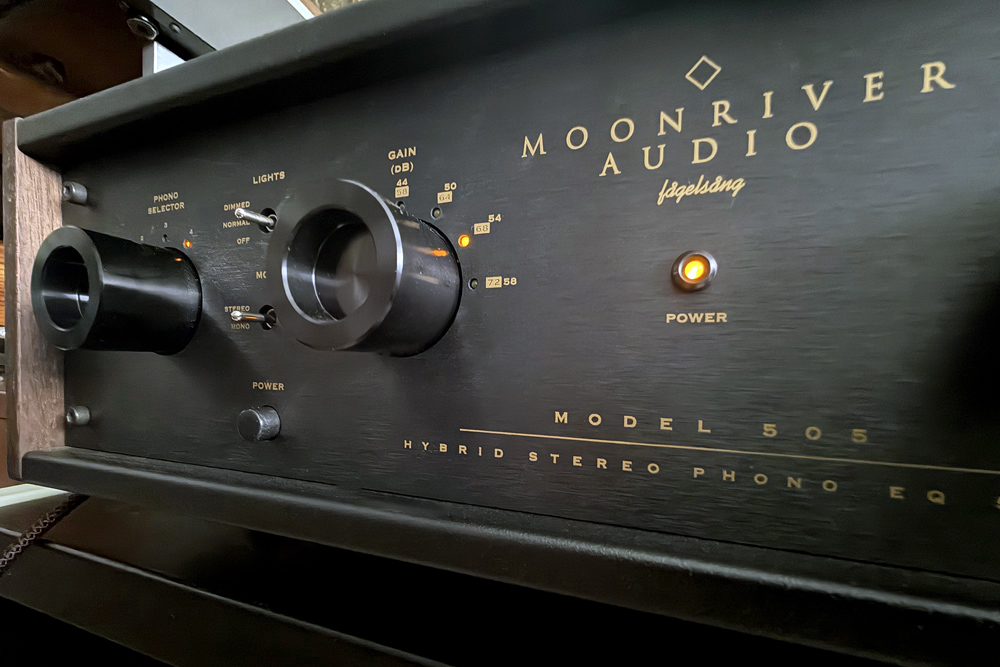
Looking at the front panel controls on the Moonriver 505 reveals the many options available to the vinyl junkie. The black anodised and brushed aluminium front panel has four large round rotary controls which cover, from left to right, the phono input selector with four inputs, a gain selector with six gain settings for Moving Magnet and six settings for Moving Coil type cartridges.
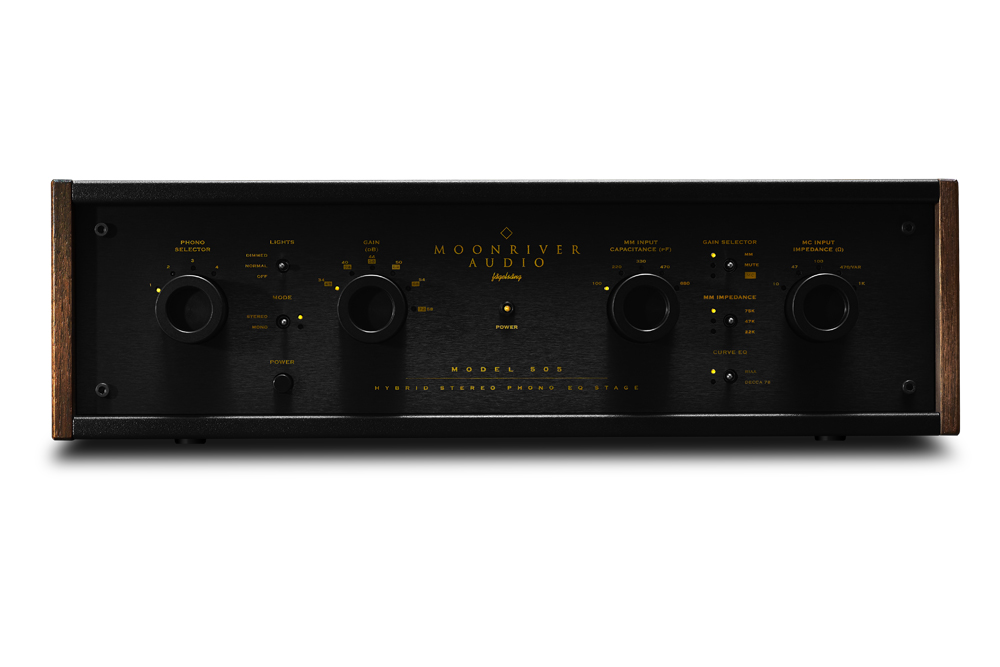
The gain settings for MM are 34, 40, 44, 50, 54 and 58 dB while for the MC there are 48, 54, 58, 64, 68 and 72 dB. The third control covers five capacitance inputs for Moving Magnet, and they are 100, 220, 330, 470 and 680 pF, and the fourth rotary has five impedance settings 10R, 47R, 100R, 470R (changeable via internal trim pots and digital meter with options of 0-870R). For Moving Coil types there’s a 1 Kohm setting. The four controls connect to microcontrollers which also indicate the selection via orange LED lights.
A small on/off button is located on the bottom left-hand side, with the designer opting to remove a standby setting to prolong the life of componentry and reduce unnecessary power consumption. Above the power button are two sprung-loaded metal toggle switches, one for stereo or mono output and the toggle above is for the display lights that can be left on, dimmed to 50% or turned off altogether.
On the right hand-side of the front panel are three more sprung-loaded toggle switches that operate, RIAA for modern recordings or a DECCA curve EQ for 78 rpm records (a Columbia curve is available from Moonriver). A Moving Magnet Impedance setting with three options are available at 22K, 47K and 75K, with the 22K and 75K options provided for high output Moving Coil cartridges. Finally, a Gain Selector which toggles between MC, Mute and MM.
As the Moonriver Model 505 can take four different cartridge/tonearm combinations, the user sets the required parameters for the individual cartridge under input 1 to 4. The chosen inputs are stored by the phono stage and are kept in the microcontroller memory. Any further input changes are again stored automatically. When switching between inputs the Moonriver goes into mute mode to prevent unwanted noise through the speakers.
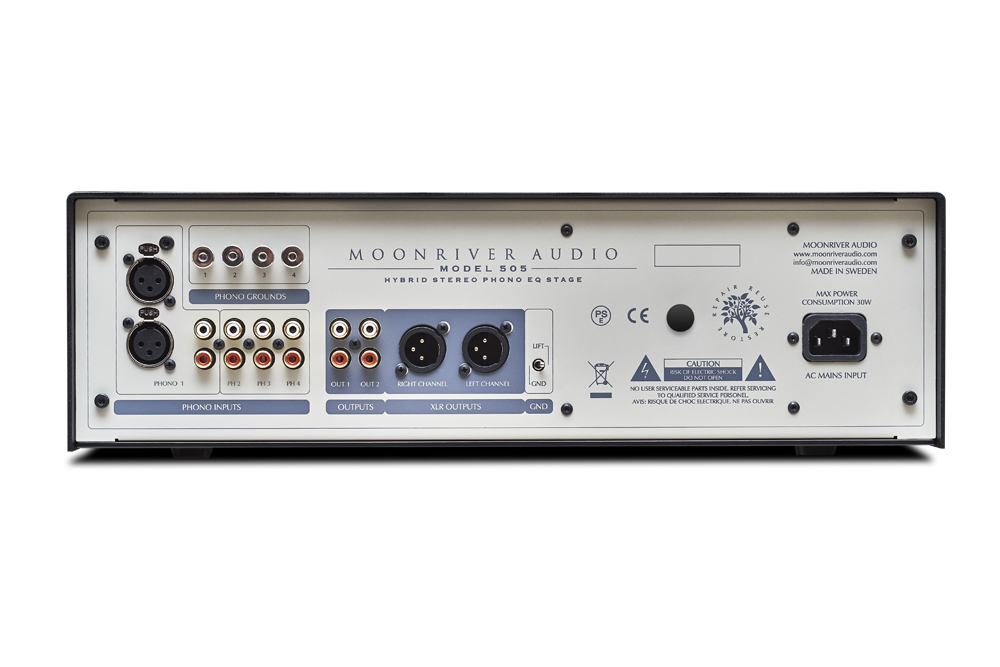
Around the back of the Moonriver are four inputs with input 1 an XLR type and inputs 2, 3 and 4 being RCA types. The four individual earth binding posts on the 505 will be a joy for the user, negating the juggling act needed to fit four fiddly earth wires on a single post! Next are two RCA outputs for use with a preamplifier or headphone amplifier, also included is an XLR output, however, Moonriver states that the XLR should not be used at the same time as the RCA outputs. An earth switch with the option to lift or ground, the unit is set to the lift position. An IEC plug allows the buyer to select their own power cable.
Constructed from folded steel plate and aluminium with small timber side cheeks, the Moonriver 505 phono stage shows design cues from the 1970s, with the designer stating that early Japanese Sansui components where a strong influence on the look. Inside the unit, the 505 has been divided into three areas. The faraday shielded transformer is bolted on its side to a steel 'backbone' that runs behind the front panel and the voltages are divided between six power supplies feeding the different phono sections. The main PCB contains 70,000 uF of capacitance and the active gain stages are completely shielded from the discrete components. The layout is designed to provide isolation between noise sources and the sensitive audio signal between stages while using as minimum componentry as possible along the shortest signal paths.
Built using the same chassis as the 404 integrated amplifier the 505 weighs in at 11 kilograms and its dimensions are 430mm wide, 390mm deep and 135mm high. While the manual for the Moonriver 505 Phono Preamplifier is on the smaller side, it is comprehensive in detail and has great insights into the setting of impedances for low output Moving Coils.
From old to new record pressings the Moonriver 505 phono stage was put through its paces using three turntables, four tonearms and various cartridge types. After turning the 505 on, the unit stays in mute while various relays kick-in before switching out of mute… now, it’s ready to play.
From River to Moon
The first record I spun was 1949’s Music Lessons From The Andrews Sisters featuring, of course, The Andrews Sisters and Dan Dailey. The track was “In the Good Old Summertime” on a 10 inch 78 rpm shellac cleaned with Record Restore Shellac formula. Even a good clean could not remove all the inherent noise in 78s, but what came through was enlightening. The vocals had a centre image, the soundstage was remarkably wide with plenty of dynamics on offer, and there was clarity and layering within the mix, which is remarkable considering the age of the recording.
Cutting the speed in half, next up was a mono recording from 1958, Jazz Lab, on the Prestige Label, featuring Gigi Gryce on Saxophone and Donald Byrd on trumpet. The track “Blue Lights” has solo renditions from Byrd, Gryce and pianist Hank Jones that follow the cool jazz flow that was so hot in the late 1950s. The musical flow (pun intended), dynamics and instrumental accuracy were all present with the Moonriver providing a wide and detailed soundstage that allows the listener to hear the details of the recording, including notably, the use of a mute in the trumpet.
Keeping with a chill jazz flavour, Getz A Go Go is a standout mono recording from 1964 by The New Stan Getz Quartet. It features the vocals of Astrid Gilberto and is on the Verve Label. Recorded live at Café A Go Go by recording engineer Rudy Van Gelder, the sound was very present with tube-like clarity that the 505 allows to flow through. The recording was presented in a large acoustic space, with instruments coming from between the speakers like a single source (mono), but still room filling. It’s an accurate sound, with lush vibraphone and bass notes wandering through the George Gershwin classic “Summertime”. The sax has bite and the backing has boogie. Astrid Gilberto's vocals are a joy, sweet and sultry, languid, evocative. The Moonriver gets the richness of this mono just right. It’s one of the best live recordings in my collection.
Turning the input selector to input 1 briefly mutes the output stage before bringing up the settings for the chosen cartridge. In this case, a low output 0.2 mV Moving Coil, playing the Concerto No1 in A Minor for Cello and Orchestra, Opus 33 by Saint-Saens on the 1980 digital recording from the CBS Masterworks Label. Appearance by Yo-Yo Ma on cello and with Lorin Maazel conducting. My listening notes mention the insightful intensity to the dynamics, with the soundstage now extending beyond the speakers. The cello was sweet in tonality with the range of dynamics accurately portrayed through the 505. The orchestra was easy to follow with good separation between instruments and there was good acoustic depth to the sound. The MC used has an elliptical stylus so hyper details are not obtainable with this profile, but the musicality, muscle and insight are all there.
Moving to a different turntable, this one was set-up with a higher output MC that has an extended fine line contact stylus. All the cartridges were set-up using protractors and test discs, where appropriate, and this MC rewarded with richer insights on the Saint-Seans recording. The tonality, details and dynamics all benefited through the open window of the Moonriver 505. The recording had more power and realism in this playback format. Even at household friendly volume the 505 still portrayed the Saint-Seans recording with dynamics, speed and subtlety.
Grover Washington Jr is in a jazz-funky mood with the 1980 release of Winelight, and it's the self-titled track that kicks off the saxophonist's set. Marcus Miller provides the bass licks on this irrepressible slice of funky and, yes, cheesy number. The production is top notch with an Aphex Aural Exciter being used in the mixing of the album. Whatever it was the Moonriver handed out a lush sound, dense and detailed, quiet and subtle when needed. The alto sax stayed earth bound and not shrill, just forceful with sweetness, the backing band playing cruisy beats.
Enough rich fare. What about some roughage from the late great rockabilly/punk band The Cramps? Spinning the 1977 EP Gravest Hits, it features such minor hits as “Human Fly” and a cover of The Trashmen's “Surfin' Bird”. Running at 45 rpm Track 1 is “The Human Fly” which begins with Nick Knox on drums and Poison Ivy on bass laying down a beat/bass heavy wall of noise, with lead singer Lux Interior expressing the downside of mixing human and fly DNA with germ warfare. It’s a heady mush of sound that must have pushed a lot of recording equipment into the red, as distortion levels are OTT. The Moonriver 505 retained the edge and swagger of the song without sugar coating the grungy mix much, while the absurd lyrics were just as much fun to hear now as they were 50 years ago!
“Surfin' Bird” launched from the speakers with distorted force and chaos, Lux Interior’s vocals are hidden in the mix and as the song progresses/collapses the chaos element gradually takes over, leaving the song barely recognisable from the original. Fun and exciting renditions from this undervalued band.
Conclusion
The Moonriver 505 Hybrid Phono Stage has been a pleasure to operate and review. Setting it up was a breeze, with logical layout and clever function operations available on the front panel. It would be perfect for the seasoned vinyl operator with more than one turntable, while also suiting the vinyl newbie due to its sensible instructions and easy connectivity.
The build quality and use of through-hole components mean that the Moonriver 505 will last for decades and provide great sounds from as many cartridges as almost any user would wish for.
Highly recommended for its excellent sound, effortless setup, and future‑proof sustainability.
… Mark Busby
www.soundstageaustralia.com
Associated Equipment
- Speakers – Yamaha NS-1000M, custom 18-inch subwoofer, Acoustic Energy AE1 Reference Mk. III
- Preamplifier – PS Audio BHK, Music First Audio step up transformer, EMIA two-box tube phono stage
- Amplifier – Yamaha B1, Musical Fidelity Tri-Vista 300, Leak Stereo 60, restored Leak Stereo 20
- Sources – Analogue: Technics SP10 Mk3 turntable with Stax UA7 Tonearm, Garrard 401 and SME V arm, Thorens TD 124 Mk1 with Woodsong bearing, SME 3012 silver wired tonearm, Vertere SG1 tonearm, Sorane ZA-12 tonearm, Fidelity Research 64S tonearm, Audiomod tonearm, Music Maker 3 moving iron & DS Audio DS-003 optical cartridges, Soundsmith Paua, Miyajima Labs Kotetu, Kiseki Blue cartridges, Supex SD-900 Mk.II, Ortofon 2M 78 MM, Tube Sound Audio phono stage, Sansui TU-717 tuner, Leak Trough-Line 2 mono tuner. Digital: Marantz CD-12/DAC-12
- Cables – Vertere Pulse-C, Revelation Audio Labs
Moonriver Audio 505 Phono Stage
Price: AU$7995
Australian Warranty: Two Years
Australian Distributor: Magenta Audio
+61 (0) 8 83901673
https://magentaaudio.com.au/
Moonriver Audio
Poststugan 532
21165 Malmö
Sweden
+46 (0) 765 905 066
https://moonriveraudio.com/