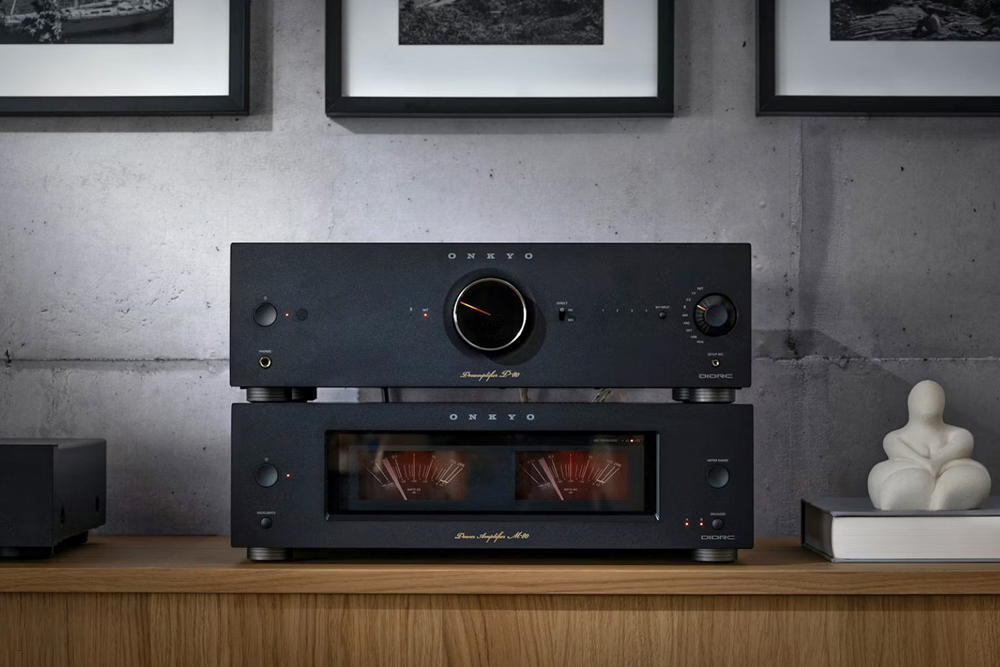
The P-80 Network Preamplifier and M-80 Power Amplifier are part of a new range of flagship products from Onkyo under the ICON series. They are both bang-up-to-date with the latest digital connectivity and analogue options, plus they hark back in time via the M-80 amplifier’s stylish real VU meters. Sporting network, Wi-Fi and Bluetooth connectivity and Class-A/B amplification, the review samples’ black chassis duo looks great straight out of the box. Before diving into the many music options available, it’s worth mentioning I’ll be tackling the analogue functionality of the P-80, with the digital features and performance aspects coming soon in a follow-up by editor Edgar Kramer. First, I’ll kick-off with a short look at the history of Onkyo the revered Japanese company behind these new flagship products.
Harmony With The Past and Present
Onkyo in Japan translates as “Sound Harmony” and the brand started life in 1946 with a record player. The late 70s was a busy period for Onkyo with the company releasing a variety of audio components, including the direct-drive CP-700M turntable and the Grand Integra M-508 and M-504 power amplifiers, whose VU meters are closely echoed in the M-80 power amplifier being reviewed here. A brief period in the 2000s saw the Onkyo brand disappear from the market, but timely restructuring brought the company back to its rightful place as a stalwart of Japanese Hi-Fi. Now in its 80th year and revisiting premium audio gear, Onkyo has released the ICON series which includes a stand-alone C-30 CD player, the A-50 integrated amplifier, and the subjects of this review, the P-80 and M-80 separates.
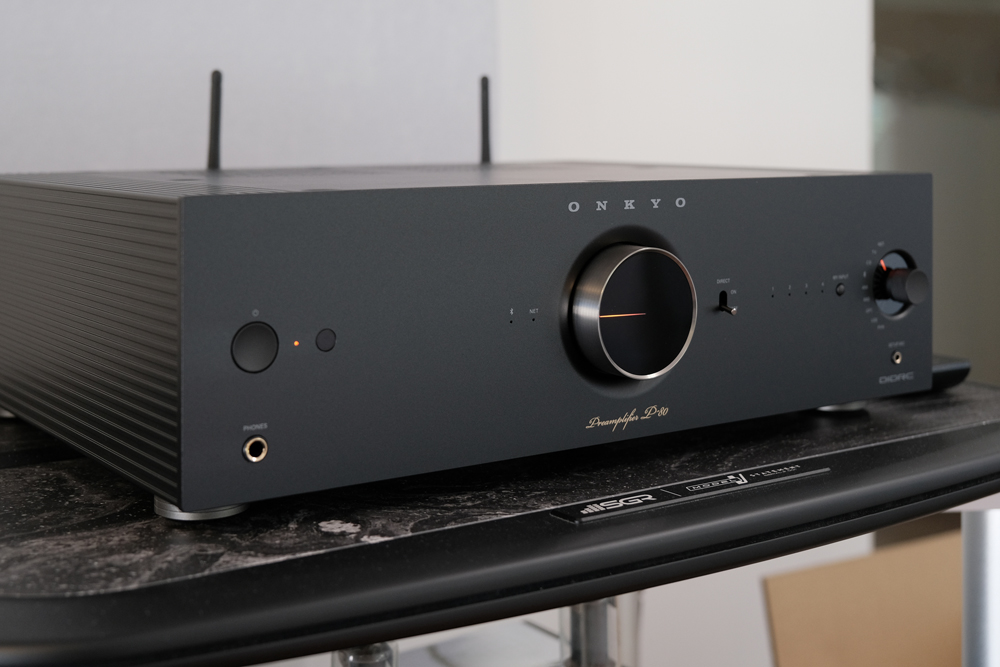
Starting with the P-80 Network Preamplifier, the front panel is best described as functional minimalism. There’s a large, backlit powered volume control in the centre while on the extreme right hand side is an input selector, also backlit. Below the input rotary knob is a microphone 3.5 mm jack for setup for the in-built Dirac Live Room Correction (supports Dirac Live Bass Control as an optional upgrade). Across to the left is the on/off button, below that a 6.5 mm headphone output jack. Small LEDs provide Bluetooth and Network status.
The input selector can allow the user to set specific input settings via a small switch, next to the input, called MY INPUT. An on/off toggle marked DIRECT engages tone controls or bypass for a cleaner electronic path. The Onkyo P-80 preamplifier weighs in at 9.5kilograms and is sized at 435 x 135 x 355 mm deep. It’s available in Black or Silver finish.
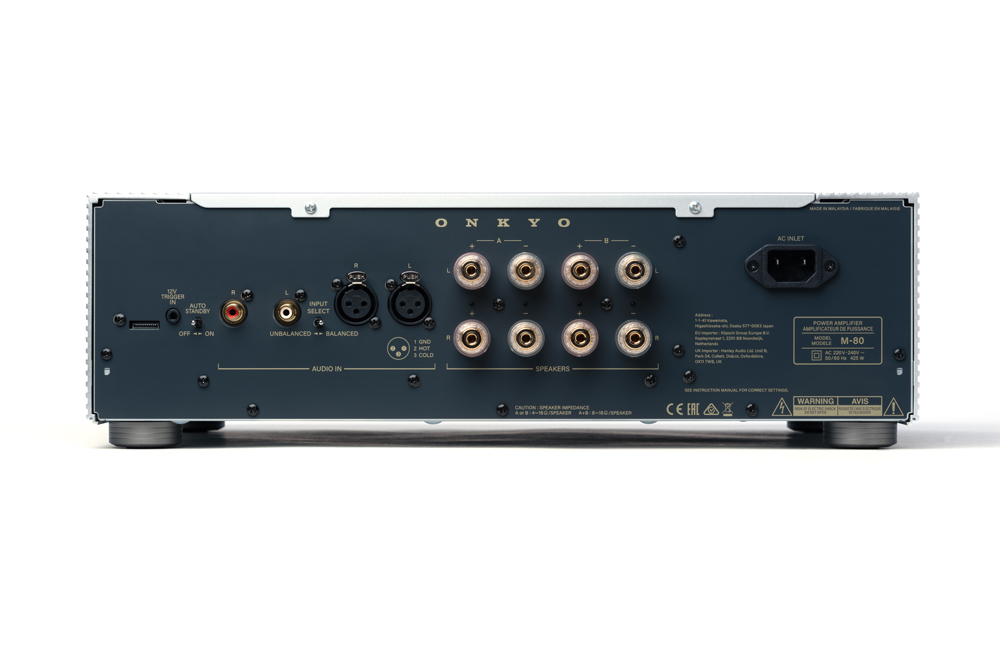
Around the back you’ll find provision for two aerials, one each dedicated to Wi-Fi and Bluetooth. Below these sit inputs for TV (ARC), USB-A (5V/1A), and an RJ45 ethernet port. Below these from left to right are the Phono input RCAs, the MM/MC switch (Moving Magnet/Moving Coil), and a grounding post. Digital inputs are in the form of S/PDIF coaxial and separate optical in/out. Next, are two line level RCA stereo input sockets and RCAs for two subwoofer outputs (switched via the Onkyo App only).
Preamplifier outputs are via a set of unbalanced RCAs and balanced XLRs. A 12 Volt trigger output jack and an IEC socket finish the rear connections. A black plastic remote comes with the units which allows the user to turn the P-80 on and off, selects inputs, includes controls for the C-30 CD player, volume setting and finally tone controls. While adjusting the tone controls the volume’s orange lights act as a bar graph for a simple reading of tone position.
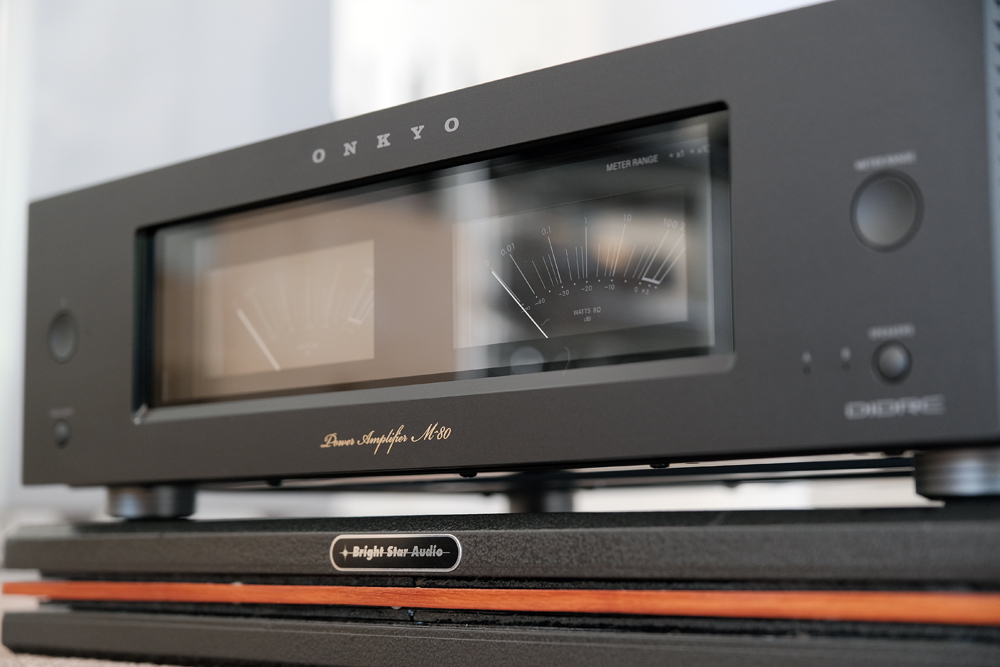
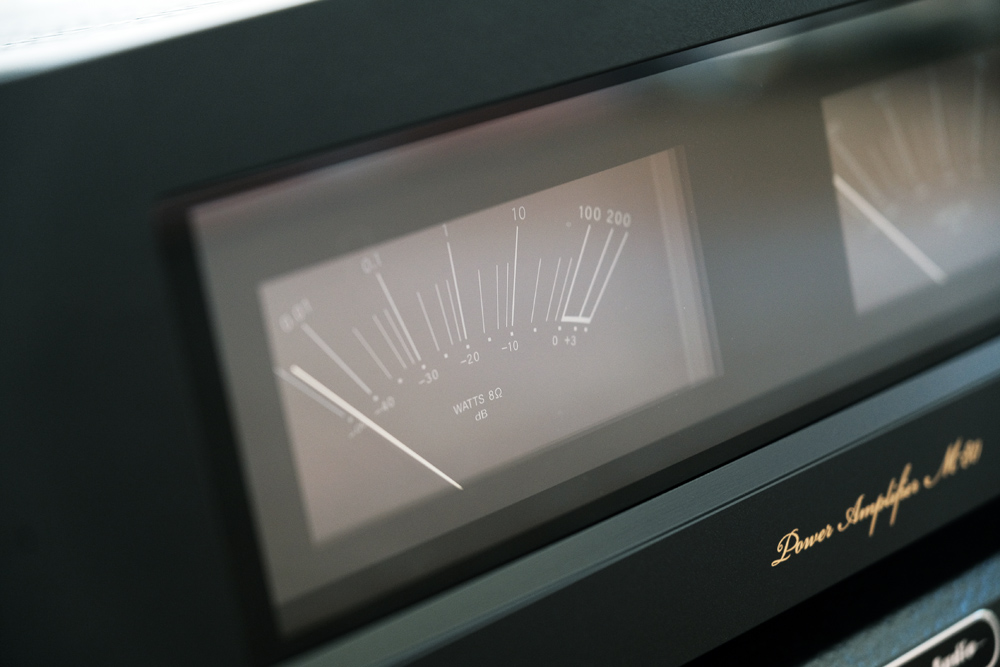
The M-80 power amplifier front panel sports the on/off button, the large orange backlit VU meters, a meter range button, a backlight switch and speaker buttons. Around the back are the 12-volt trigger jack, an auto standby switch which turns off the unit when signal is undetected for a period of time. Outputs include a pair of unbalanced RCA and balanced XLR connections. Two sets of speaker binding posts that accept spade, bare wire and banana plugs are available, however, only one set of speakers can be played at a time.
The amplifier section uses a Class-A/B Inverted Darlington three-stage circuit which produces 130 watts into an 8 ohms load (20 Hz to 20 kHz, Total Harmonic Distortion (THD) at 0.07% with two channels driven). Onkyo quotes the 4 ohms output at 200 watts at 1 kHz. Frequency response is given as 5 Hz to 100 kHz (+1dB/-3dB).
It’s a low Negative Feedback (NFB) and high slew rate design using paralleled transistors said to provide “instantaneous current supply capability”. Onkyo states the M-80 incorporates a high current power supply featuring a 10,000 microfarad capacitor bank (the capacitors are custom made for Onkyo). The M-80’s driver stage uses Onkyo’s patented DIDRC (Dynamic Intermodulation Distortion Reduction Circuitry) which is said to reduce noise in the ultra-high frequency band. The power amplifier weighs in at 13.5 kilograms, is the same-sized chassis as the P-80 preamplifier and is also available in silver or black finishes.
Connections between the P-80 and M-80 is via RCA unbalanced and XLR balanced cables and there is no ability to switch between the two. Generally, the XLR option is considered the best when using long cables between the P-80 and M-80. Removing the RCA or XLR cables essentially revealed similar sound characters, probably due to the use of short cable lengths in this setup.
As described above, the P-80 Network Preamplifier is well appointed with comprehensive connectivity. Also mentioned in this review’s introduction, this review will assess the analogue line and phono inputs. Legacy CD transport/player connections will be explored with the DIRECT toggle turned on, removing the tone controls from the circuit. I’ll also be testing one of the analogue inputs with the classic Leak Trough-Line 2 FM tuner (a mono valve reader of the FM airwaves). The Trough-Line 2 requires a 300 ohms aerial mounted outside to perform, but when it does, the fidelity is very good, especially with live recordings.
Analogue Explorations
Connected to Acoustic Energy AE1 Reference Mk. III standmounts, the Onkyo duo allows the purity of the music to come through, retaining the sweet sound of a French horn to float out of the speakers sounding rich and organic. The piano sounds dynamic and the sustain clear, the solo clarinet rich and sombre, the two instruments playing around each other was captivating. Having tried the Onkyo pairing with the venerable Yamaha speakers, they were found to be a poor match. The also excellent Acoustic Energy AE1 Reference Mk. III seem much happier.
I engage line input 2 with my own phono stage for some vinyl and it does sound great with recordings from the late 50s to early 60s. Yep, some more mono, but hang-in there because this stuff is recorded on the end of a chain of valves and transformers and they have a special sound. Milt Jackson, Ella Fitzgerald and Diana Trask all are a sonic pleasure through the Onkyo pairing and the external phono gear.
The P-80 preamp has a nice touch with the inputs: phono, USB, optical Toslink, analogue 2, analogue 1, Bluetooth, CD, TV and Network are arranged around the dial in a 1/3 arc, while next to the chosen input a small LED strip lights up in the same orange glow that ties-in with both ICON components.
The last of the inputs I selected is connected to my modded, and iconic, Marantz CD-12 transport and DA-12 digital-to-analogue converter combo. Ali Farka Touré, the ‘King of the Desert Blues’ singer’s Savane CD, is first in the tray. His laconic and strangely syncopated style of guitar playing comes across as well defined, crisp and engaging. The guitar tones are well conveyed and micro percussive notes are clear and precisely placed at the rear of the tall central image. The female backing vocals have a lovely harmonic tone and softness to them that sounds just right in this system.
Cat Power’s The Greatest is not a compilation of hits but a tongue-in-cheek album of songs from chanteuse Chan Marshall. The song “The Greatest” is a laid-back number with piano, strings and drums backing Cat as she croons in a 60s style. The soundstage has good depth and width, separation and placement of instruments is well defined, and the sound is overall refined. Nothing digital or harsh sounding, so Onkyo’s claim of producing music from CD and streaming sources to sound as analogue as possible sounds correct. Onkyo’s DIDRC (Dynamic Intermodulation Reduction Circuitry) is effective. The circuitry is also used in the P-80 onboard DAC and Phono inputs.
Switching over to the DAC section, fed from the CD-12 transport, reveals that the Onkyo P-80 DAC is clean, crisp and dynamic with no harshness to the sounds, again an analogue relaxed flow from the music to the Acoustic Energy AE1 Reference Mk. III speakers.
Next, I tried the onboard Phono stage, which accepts one turntable input selectable in either Moving Magnet or Moving Coil via a sliding switch located alongside the phono RCA inputs. This is a small switch which may have to be moved into the correct position before sliding the P-80 into the rack. Using a NOS Supex SD-900 Super Mk.II Moving Coil, I soon found that the 0.2 milli-volt output is just too low for the MC section of the Onkyo P-80, so the cartridge was connected to the Moving Magnet section via a Step-Up Transformer… some lovely sounds where produced.
The London-based duo calling themselves Loaded Honey on the album Love Made Trees is a dreamy pop album using subtle distortions and vinyl crackles to embellish singer Lydia Kitto’s voice. There’s an intoxicating ethereal quality to the songs. The sound is sweet and highly engaging; separation of instruments is very good. The Onkyo P-80 phono stage is revealing and dynamic even if the MC section is best used for higher output types.
During use of the P-80 preamplifier it was noticed that on switch-off the volume control automatically dials down before powering down. After turning on the P-80, it remembers the last input selection and volume level. Clever, but beware if you had it at party levels the night before!
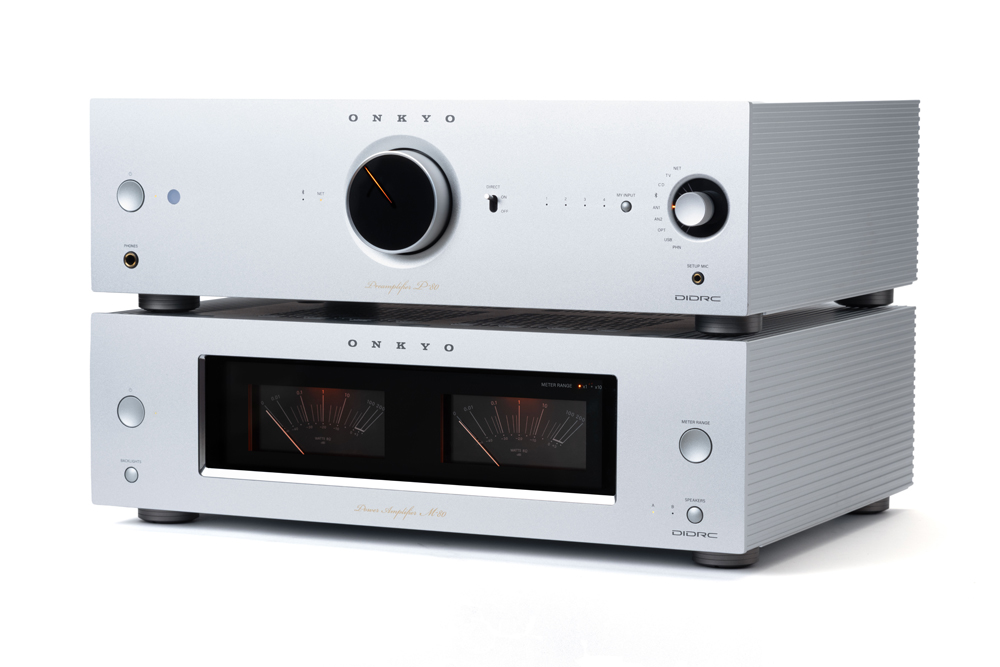
Of note, when the M-80 power amplifier is switched on, the unit starts in protection mode before the speaker relays’ audible click. Then, the M-80 is ready to play. The mighty VU meters take up most of the front panel’s real estate and have two ranges: X1 for louder listening and X10 for lower volumes, however, I’m sure most users would enjoy seeing those meter needles play along with the music. The accuracy of the P-80’s VU meters is spot-on, and that precision is a representation of the musical and sonic performance the Onkyo pairing produces. The orange backlighting can be turned off with the press of a button on the front, but who would want to?
Conclusion
The Onkyo P-80 Network Preamplifier and M-80 Power Amplifier are a welcome return for this long-running Japanese brand. The two products showcase how a modern and versatile approach to connectivity can blend with old school phono replay and a somewhat retro styling and lighting scheme. Being able to use the pair in the context of a 2-channel stereo or TV setting is a bonus which enhances an already flexible package.
Welcome back Onkyo!
NOTE – Edgar Kramer's follow-up review of the P-80’s digital features, onboard DAC, and streaming functionality coming soon.
… Mark Busby
www.soundstageaustralia.com
Associated Equipment
- Speakers – Yamaha NS-1000M, custom 18-inch subwoofer, Acoustic Energy AE1 Reference Mk. III
- Preamplifier – PS Audio BHK, Music First Audio step up transformer, EMIA two-box tube phono stage
- Amplifier – Yamaha B1, Musical Fidelity Tri-Vista 300, Leak Stereo 60, restored Leak Stereo 20
- Sources – Analogue: Technics SP10 Mk3 turntable with Stax UA7 Tonearm, Garrard 410 and SME V arm, Thorens TD 124 Mk1 with Woodsong bearing, SME 3012 silver wired tonearm, Sorane ZA-1 tonearm, Music Maker 3 moving iron & DS Audio DS-003 optical cartridges, Soundsmith Paua, Miyajima Labs Kotetu, Kiseki Blue cartridges, Tube Sound Audio phono stage, Sansui TU-717 tuner, Leak Trough-Line 2 mono tuner. Digital: Marantz CD-12/DAC-12
- Cables – Vertere Pulse-C, Revelation Audio Labs
Onkyo ICON Series P-80 Network Preamplifier and M-80 Power Amplifier
Price: P-80 AU$4299, M-80 AU$4299
Australian Warranty: Two Years
Australian Dealer Finder: NA
Australian Distributor: Westan
+61 (0) 3 9541 8888
https://www.westan.com.au/
ONKYO Corporation
MMEETT Building 301, 1-3-9, Minamisemba
Chuo-ku, Osaka 542-0081
Japan
+81 06 6271 0005
https://www.onkyo.net/en